 |
Stories from the NFCCA Newsletter, the “North Four Corners News” |
|
Stories from the NFCCA Newsletter, the “North Four Corners News” |
North Four Corners News ♦ April 2023
Thinking of adding lights to your driveway to keep better track of your cars at night? Keeping your porch light on to feel safer around the house? The cost is small and bulbs last longer than ever, so why not? Yet while the introduction in recent years of cheaper light sources — such as LEDs — has made it tempting to use more lighting for outdoor purposes, regular exposure to light during nighttime hours not only hurts wildlife, but also has a negative impact on humans.
Artificial light causes several problems for wildlife, especially those animals that are nocturnal (active at night). This includes:
In addition to wildlife, exposure to artificial light also impacts plants and trees. Different plants need different photoperiods, or certain lengths of night and sunlight, to grow properly. Increased light exposure impacts pigment formation, leaf shedding, bud dormancy, and behavior of pollinators. In the case of trees, those leaves closest to light sources stay on the longest, sometimes weeks longer, in the autumn months when the leaves of trees change color and fall. This could result in stressed plants and trees, or plants that do not grow properly.
The damage from artificial light doesn’t stop at wildlife. Humans, while feeling safer in locations that are lit, need darkness as well. Humans need dark conditions to produce melatonin, a hormone that is necessary for the body to repair its cells. Serious interruption to the circadian rhythm and day/night pattern interferes with this production and has been found to result in higher rates of some cancers. Artificial light exposure, especially at night, has also been linked to increased rates of insomnia, headaches, cardiovascular disease, diabetes, anxiety, obesity, depression, and vision problems.
LEDs (light-emitting diodes) have become widely available and popular over the last 15 years. Their popularity stems not only from their longevity but the fact that they use a fraction of the electricity as traditional incandescent light bulbs. However, not all LED light bulbs are great for humans and wildlife. LED light bulbs in the blue and purple-rich wavelengths have been shown to pose serious risk to the environment and human health, as the longer wavelengths bounce around the sky and atmosphere, appearing brighter to wildlife, possibly even blinding them.
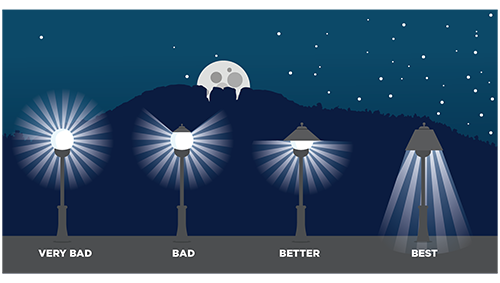
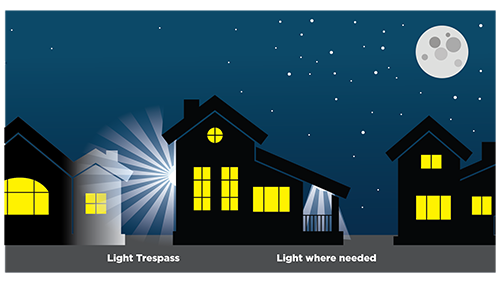
If you must use artificial outdoor lighting, consider the following:
[Both graphics are from the City of Fort Collins, Colorado, and used with permission.] ■
Dark Skies 2002© 2023 NFCCA [Source: https://nfcca.org/news/nn202304g.html]