 |
Stories from the NFCCA Newsletter, the “North Four Corners News” |
|
Stories from the NFCCA Newsletter, the “North Four Corners News” |
North Four Corners News ♦ December 2025
Councilmembers Friedson, Fani-Gonzalez, and Jawando serve on the Planning, Housing, and Parks Committee (PHP Committee) of the Montgomery County Council, which has concluded its series of Work Sessions on the “Planning Board Draft Summer 2025” for the University Boulevard Corridor Plan (UBCP).
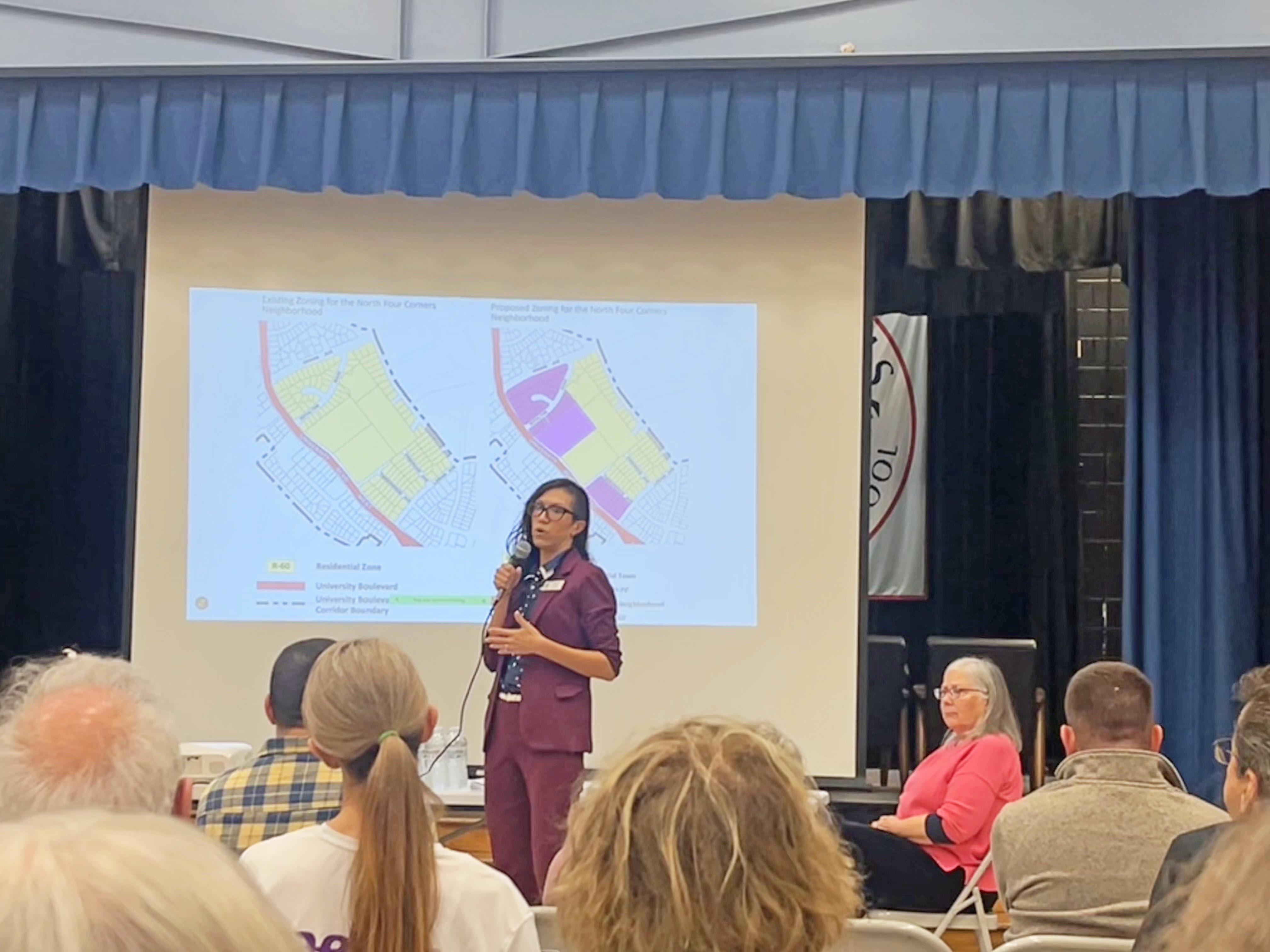
Although not on this committee, Councilmember Mink — who represents District 5 (including the NFCCA community) — actively participated in these work sessions. She sent a detailed letter on 26 September to Council colleagues laying out her concerns with the UBCP, with the following requests: (1) eliminate the street grid that impacts South Four Corners; (2) reduce the height proposed for Commercial Residential Town (CRT) zoned properties near Four Corners; (3) remove the recommendation to repurpose existing general traffic lane for a bus-only lane near Four Corners; (4) remove the Phase 2 transportation recommendations for Four Corners; and (5) either remove entirely or significantly scale back the proposed rezoning of single family properties. For a copy of this letter, see the second document attached behind the staff report at the link below.
Staff ReportThe PHP Committee agreed to a number of significant changes to the UBCP. By a 2-to-1 vote, the PHP adopted Chairman Friedson’s amendment to cut back the areas proposed for rezoning as Commercial Residential Neighborhood (CRN) throughout the length of the corridor. CRN zoning allows higher density housing redevelopment (duplex, triplex, quadplex, and small multifamily up to 19 units).
The Friedson amendment applies CRN rezoning only to the single-family homes that directly front University Boulevard from Caddington to Sutherland, as well as homes 10200 to 10226 on Colesville Road between Timberwood and Lorain. For a map of the properties affected by this amendment, see page 20 of the Staff Report to the PHP at the link below.
PHP Staff ReportThe properties along University Boulevard and Colesville Road were already upzoned by Zoning Text Amendment 25-02 (Housing N.O.W.) previously enacted by the Council. A newsletter article described Housing N.O.W. is at the link below.
Read StoryThere are important differences, however, between Housing N.O.W. and the CRN rezoning as proposed by the UBCP.
A building’s square footage can be slighter higher under Housing N.O.W. as the Floor Area Ratio (FAR) is 1.25, but is lower at FAR 1.0 for CRN. For example, on a 5,000 square foot lot, Housing N.O.W. allows a building up to 6,250 square feet vs. 5,000 square feet for a CRN-zoned building. Housing N.O.W. restricts building height to 40 feet, but Friedson’s amendment will allow buildings up to 45 feet (lower than the 50 feet height recommended by the Planning Board’s original recommendation).
Lot coverage — that is, the percentage of a site covered by the building — is similar for smaller lots at 30 to 35%, but can go up to 90% for larger CRN-zoned lots greater than 15,000 square feet. Front, side, and rear setback requirements are also narrower for CRN-zoned lots.
Under Housing N.O.W., a redeveloper may seek Planning Board approval to reduce required parking below two spaces per unit; in contrast, only one parking space per unit is required under the UBCP because proximity to public transit qualifies this corridor as a Reduced Parking Area.
Housing N.O.W. limits lot consolidation to a maximum of up to three properties; the lots must abut the corridor and “flag” lots (with an access driveway leading off the corridor to the lot) or “through” lots that abut two roads are not eligible for consolidation.
In contrast, CRN zoning gives redevelopers more flexibility to purchase and consolidate an unlimited number of lots so long as they have frontage on University Boulevard or Colesville Road. Although the properties at 611 and 613 University Boulevard are flag lots, the UBCP, as adopted by the PHP, rezones these as CRN and they will be treated as fronting the corridor. CRN zoning will apply the duplex site standard method of development.
A redevelopment application under Housing N.O.W. is considered by the Planning agency under a streamlined optional method workforce housing development process. A redeveloper will only need to submit a site plan and, once approved, a building permit will be issued to proceed with construction. The process for CRN zoning is more streamlined as redevelopment is “by right,” so the redeveloper simply needs to secure a building permit.
A chart illustrating the differences between Housing N.O.W. and CRN zoning can be found on the 16th page of the document in the link below.
See ChartAnother concern raised during the PHP work sessions, particularly by Jawando, was that redevelopers could buy up the supply of market rate affordable single-family housing in one of the most diverse and relatively affordable areas of the county. Prior to consideration by the full Montgomery County Council, Friedson and Fani-Gonzalez sought to bring the UBCP more in line with the affordable housing requirements under Housing N.O.W.; they forwarded a proposal to add a requirement to the implementing Overlay Zone text amendment, ZTA 25-12, that any 3+ unit redevelopment of CRN properties have at least one Work Force Housing unit, or 15% of the total units, whichever is greater. ZTA 25-12 will be considered by the full Council in December.
In the “Four Corners Town Center” at the intersection at University Boulevard and Colesville Road, the UBCP recommended Commercial/Residential Town (CRT) zoning, which allows greater density for mixed-use redevelopment with commercial, retail, and housing. The PHP Committee chose to grandfather the existing zoning with a 100-foot height limit on several commercial properties at the corner of Lorain and University. PHP did, however, generally lower the CRT height limits applicable to other sites throughout the Four Corners commercial area to 60 feet, which is well below the 75- to 100-foot heights recommended by the Planning Board. Slightly higher height limits of 65 feet apply to the properties in the median islands between east- and west-bound University Boulevard, as well as the Safeway site.
The UBCP recommends developing University Boulevard as a “Cool Corridor” with tree canopy, shaded transit stops, landscaped buffers, and improved stormwater management. To make the experience more pleasant and safer, the PHP embraced the UBCP recommendations to widen sidewalks and add a green “buffer” separating the sidewalk from traffic lanes. To make space for this, the PHP decided to narrow existing lanes and repurpose a lane in each direction for these safety improvements, as illustrated below.

Although the Planning Board had also pushed for a dedicated bus-only lane running through the Four Corners intersection, the PHP Committee chose not to adopt this recommendation, deciding instead to “evaluate options to improve transit performance through Four Corners, including transit signal priority or relocating bus stops. The adopted recommendation is to extend the dedicated bus lane with red pavement from Dennis to Lorain and pick up the dedicated bus lane again at Williamsburg Drive to the Beltway exit at the plan’s eastern edge.

The PHP, however, reaffirmed the recommendation for dedicated median bus lanes on Colesville Road between Timberwood Avenue and the outer loop Beltway ramp. The plan contemplates relocating the Flash Bus Rapid Transit (BRT) stations presently located in front of the Four Corners Pub and Montgomery Blair High School to a two-lane wide station in the middle of the Four Corners intersection. An illustrated “roll map” showing the current design for this intersection can be found at the link below (excerpt shown above).
View Roll MapFriedson made the case and added language to consider the possibility of reopening the now vacant building in North Four Corners Local Park as a public amenity space. After this recreation center was decommissioned as a parks building, it was leased for a handful of years as a Montessori school. Since that lease expired, the building has lain vacant. The Planning Board’s UBCP recommendation had been to simply consult with the community about a suitable potential lessee. Now the language calls for identifying an appropriate use “that complements the park and addresses community needs and interests.”
The County Council began its work on the PHP adopted version of the UBCP on 18 November as this newsletter went to print. A redline copy of the Council Staff’s report on the UBCP showing the changes made by the PHP to the Planning Board’s version can be found at the link below.
Redline Staff Report on UBCPPlanning Board documents and other critical information can be found on NFCCA’s website at the link titled “Montgomery County Planning” at the link below. There is background and information — such as how to write a letter to the Council expressing your views — sample pro and con issues to raise in a letter, and contact information on where to email a letter. ■
NFCCA MoCo Planning Page© 2025 NFCCA [Source: https://nfcca.org/news/nn202512d.html]