North Four Corners News ♦ December 2022
History Corner(s)
Neighbor Lucille
By David S. Rotenstein
[The Northwood-Four Corners neighborhood has several historic homes inside its boundaries.
Perhaps its best known is the 1939 World’s Fair Home on Sutherland Road. We lived down
the street from this house and it has been part of my research world since 2009. This summer,
the National Council on Public History published my latest essay about the home and the first family
that lived there. It focused on Lucille Walker, a Black housekeeper and babysitter employed by
Mario and Pauline Scandiffio. The June 2022 article is reprinted below.]
On the morning of 1 April 2022, I was among throngs of remote researchers who visited the
National Archives and Records Administration website to access data from the newly released
1950 Census. I had waited thirteen years to answer one research question: Who was the
Black woman working in a family home that I had first researched in 2009? I found her quickly
on that spring morning after I entered the family’s name and location into the website’s
search form: Lucille Walker, a 40-year-old Tennessee native. This essay explores the
intersections of collaborative research, social history problems, and the newly released census
forms as a window into segregated residential subdivisions. The data offers historians
opportunities to decenter the white developers and homebuyers who dominate much of the existing
literature on suburbanization in the United States.
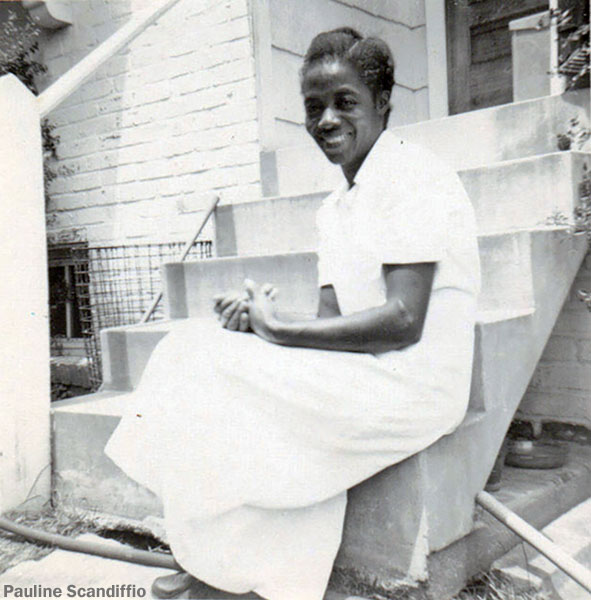
Lucille Walker on porch at the Silver Spring World’s Fair Home. Photo c. 1950 by Pauline Scandiffio. Used with permission of Ann Scandiffio.
Walker’s identity had been an unanswered, and potentially unanswerable, question when I was
first researching the history of a home in my neighborhood in Silver Spring, Maryland, just outside
of Washington, D.C. I lived in a residential subdivision laid out in 1936. The
developers launched their annual sales campaigns around model homes tied to a theme, and a modest
Cape Cod home a block away from my own had been their 1939 model home. To better understand
the home’s history and its first owners, I tracked down their daughter, Ann Scandiffio, who
lived in North Carolina.
In 2009, Scandiffio could only remember her family’s housekeeper’s first name,
Lucille, and the name that she had called her as a toddler: “Sha.” Finding
Walker’s full name and additional biographical details offered me a chance to revisit my
earlier research, which had focused on developers who reproduced one of the homes in the
1939 World’s Fair Town of Tomorrow.
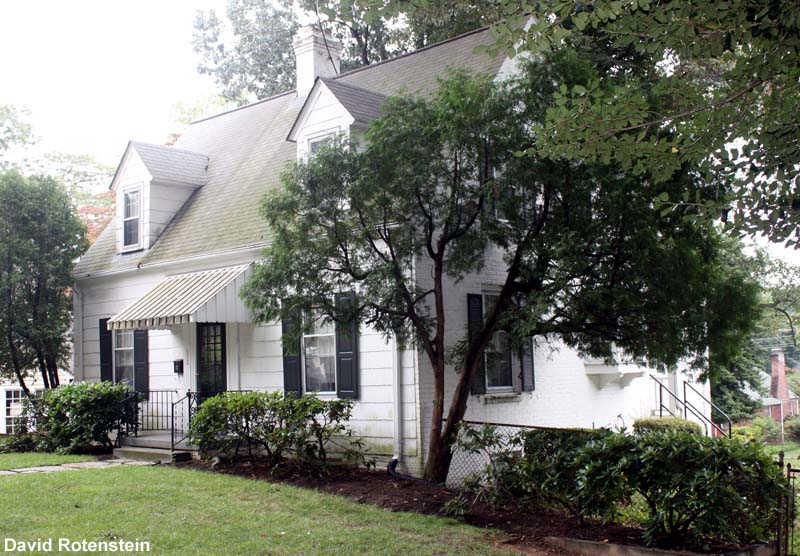
Silver Spring World’s Fair Home in 2009. Photo by David Rotenstein.
The 1950 Census release gave me a chance to reconnect with Ann, who also used the data that first
day it became available. After a decade of work documenting erasure and racism in
historic preservation, I had different questions about the Scandiffio family home, centering on the
White family (the Scandiffios) who bought the home in a racially restricted subdivision (developed
in a sundown suburb) and the Black woman (Lucille Walker) who lived with them.
Black in White Space
Ann Scandiffio’s parents, Mario and Pauline, bought the house in August 1939. He was a
pediatrician, and she was a former federal employee and nightclub singer. Like many homes
built and sold in the United States before 1948, their new home had a covenant attached to the deed
prohibiting all but persons of the “White or Caucasian race” from buying or renting the
property.

Northwood Park racial restrictive deed covenant. Montgomery County Land Records, Deed Book Vol. 648, p. 193.
There were 207 homes, housing 723 people, in the Northwood Park neighborhood in 1950. Only
three of these people were not white: a Chinese newspaper correspondent and two Black women
working as housekeepers — Lucille Walker and Blanche Young. Northwood Park and its
counterparts throughout the nation were white spaces, devoid of Black people.
Scandiffio family photos taken between 1944 and 1951 show Walker caring for Ann and her older
brother in the house and yard. “I know she was there every night,” Scandiffio told
me in a telephone interview three days after the census data release. “I don’t remember
[that] she left the house, you know, to go visit family or something like that.”
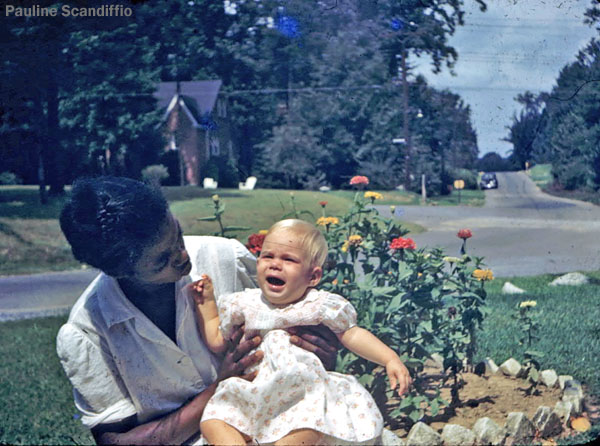
Lucille Walker and Ann Scandiffio in the front yard of the
Silver Spring World’s Fair Home. Edgewood Avenue is visible in the background.
Undated color slide by by Pauline Scandiffio. Used with permission of Ann Scandiffio.
Except for the 1950 Census, Lucille Walker is invisible in Northwood Park’s history.
Yet, she and the scores of other Black women who “lived in” — residing in their
employers’ homes — were integral members of twentieth-century urban and suburban
households. Looking for and recovering their stories in white spaces has been one of my
research objectives since I began examining suburban gentrification and erasure.
The Census Opens Doors
In 2022, many of the people in the 1950 Census can still tell their own stories of life during
Jim Crow segregation. Ann Scandiffio was five years old when enumerator Mary Kelso knocked
on her family’s door and about seven when her family moved to Florida in 1951.
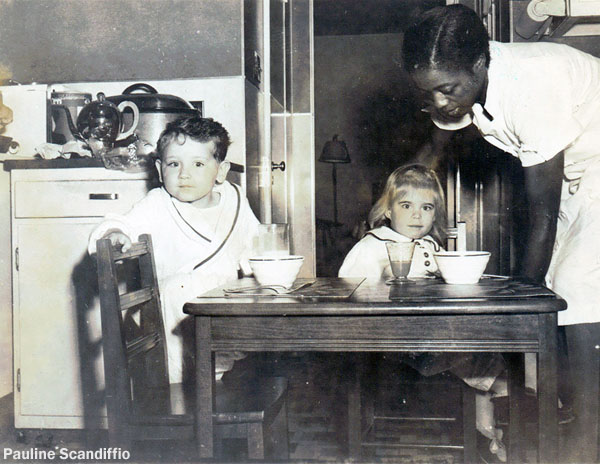
Lucille Walker and Scandiffio children inside the
Silver Spring World’s Fair Home kitchen. Undated photo by Pauline Scandiffio.
Used with permission of Ann Scandiffio.
Armed with Lucille Walker’s name, my questions opened more of Scandiffio’s
memories. She recalled that Walker traveled with the family to their summer home in
East Hampton, New York. Talking about race jogged another memory about the time
Scandiffio’s family came back to Washington for a visit.
“We stayed at the Dupont [Circle] Hotel,” Scandiffio recalled. “And when
[Walker] came to visit us, there was a big hullaballoo in the lobby because she was Black and they
didn’t want her to go upstairs. My father went down and little guy as he was, he was
very forceful about that. And he took her upstairs to our room.”
That one-hour visit was the last time Scandiffio saw Walker. Years later, her parents told
her that Lucille had died of cancer. Over the course of our recent interview, Scandiffio
recalled other details about Walker and the Scandiffio family household.
For instance, the census noted that Lucille had been divorced in 1950. “Her husband
was, I believe for a while, a handyman for us. But then evidently when they divorced, that
stopped,” Scandiffio said.
Lucille Walker can no longer tell her own story. The only evidence of her years living with
and working for the Scandiffios is limited to distant memories, family photos, and a single line in
a census population schedule denoting her relationship to them, occupation, and industry:
“maid, housework, domestic work.”
Intersections
Beyond the white space lies Black space: the African American enclaves and neighborhoods on the
sundown suburb’s margins. Interrogating the census is an opportunity to shed light into
the gender, race, and class relations in segregated suburbia. In these Black spaces, women and
men who identified themselves to census takers as “domestic workers” and
“gardeners” comprise a mostly unexplored dimension of suburban history. My search
for Lucille Walker’s story isn’t over, nor is my desire to better understand
suburbia’s full history. It’s a challenge to myself and other historians to
interrogate twentieth-century segregated spaces for information concealed by erasure and hidden
records.
[Note: The printed newsletter misidentified the World’s Fair Home as being on Lorain Avenue. The home is on Sutherland Road at Lorain.] ■
National Council on Public History Essay
NN Article on the World’s Fair House
