 |
Stories from the NFCCA Newsletter, the “Northwood News” |
|
Stories from the NFCCA Newsletter, the “Northwood News” |
A BRT-style service has been considered for Route 29 since 1996. Most recently, the State conducted a study of the BRT on Route 29 over a two-year period at a cost of between $3–$5m. I have represented the neighborhood on the Route 29 BRT Corridor Advisory Committee during this process. At the end of the two-year period, the State concluded that they could not recommend implementing BRT on Route 29 and ended their participation in this plan.
After this decision, County Executive Leggett held a press conference to announce that the County would move forward with the project anyway, without any data to support the notion that either transit time for bus riders would be decreased, or that traffic congestion would be lessened.
Much of the support for BRT is being driven by the new “Viva White Oak” development and the need for the developers to prove there is enough public transit on the corridor to support the expected increase in traffic. While billed as a job creator for the County, the developer received approval for 60 percent of the first phase of development to be residential. No major employer or anchor tenants have been announced for the site.
Shortly thereafter, without informing the Corridor Advisory Committee, the County applied for a Tiger Grant from the Federal Transit Administration and was awarded $10m towards the purchase of new buses to implement BRT on Route 29.
Costs for this project have varied dramatically from the current projected low of $31m to well over $100m. In order to raise the additional funds, the County Council voted 9–0 to borrow $21m to cover the minimum expected funds for the project.
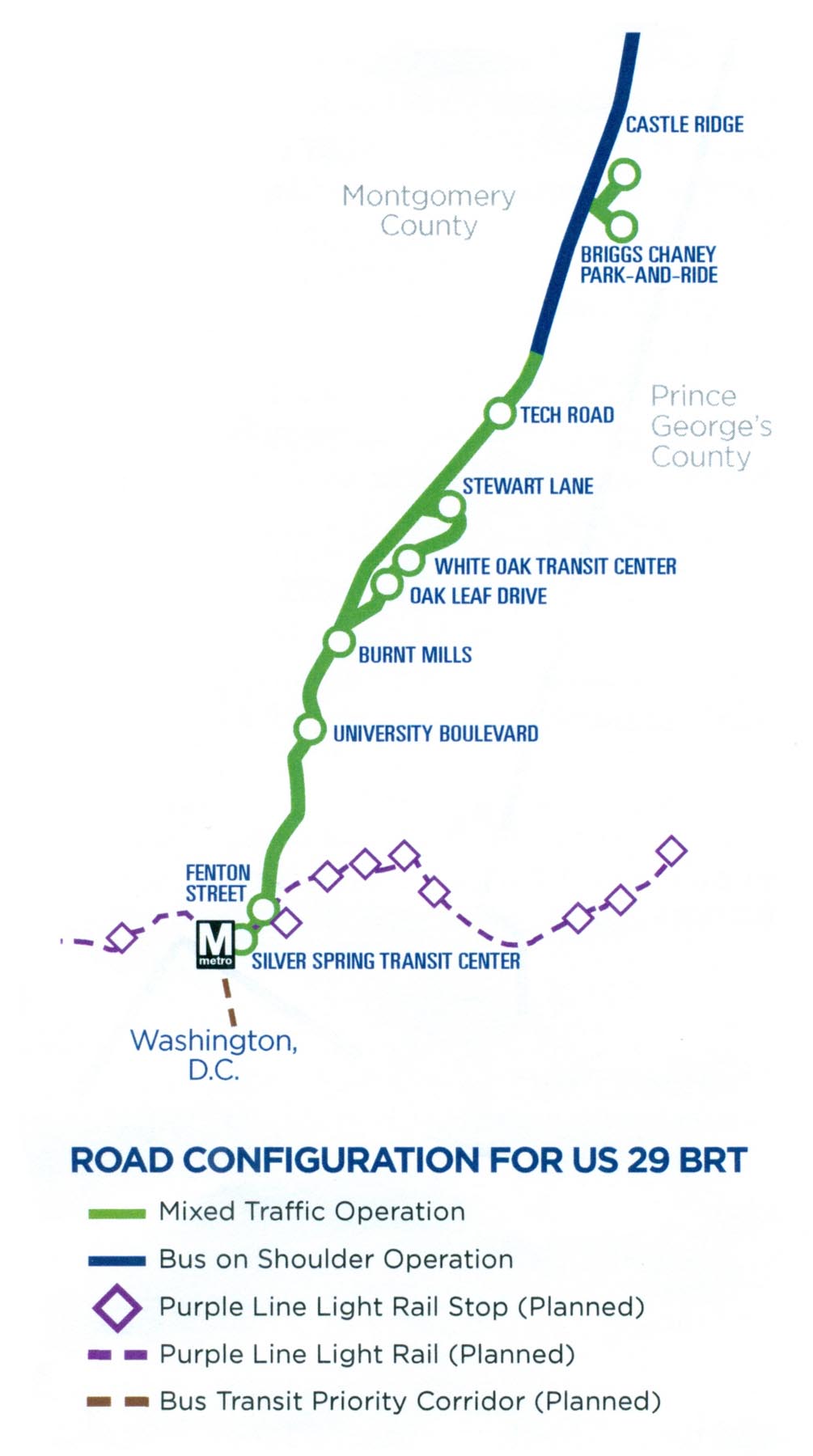
The County refused to dedicate funds to WMATA to offer this service and instead voted to give additional funds to MCDOT to dedicate a few RideOn buses to provide express service starting in January. How transit riders will be able to distinguish between regular RideOn buses and the express service is unknown and this new service has not been publicized.
This express service differs from the much-heralded RideOn Extra service recently announced for Route 355/Rockville Pike. Instead of implementing BRT on that route, the County decided to invest in a much lower-cost option, which is essentially MetroExtra but operated by the County. New buses have been purchased and equipped with Wifi, phone chargers, and transit signal priority service. This is exactly what could have been implemented on Route 29 at a fraction of the cost.
The locations of the bus stops were included in the County’s recent mailing to the neighborhood publicizing the project (shown above). All project details can be found on the County’s BRT website under the Department of Transportation.
No stations are proposed for the medians in this proposal. The southbound station will be right between the Shell station and the group of stores starting with the Metro PCS/Money transfer station. There is a parking lot there and part of that will be used for the elevated platform stations. The northbound station will be located in front of Blair High School shortly before the University Boulevard intersection.
Contrary to the County’s claim in their mailing, the impact on traffic congestion is unknown. We requested that a traffic analysis be done to determine the impact on congestion, as well as the impact on transit travel times, but the County refused to conduct a study. The project is in essence “full steam ahead.”
At the same time as the project is being implemented and the stations planned, a member of the Corridor Advisory Committee who lives in the Woodmoor neighborhood came up with the idea (not new, I should note) to put the BRT buses in the median running from New Hampshire Avenue to Sligo Creek. This idea has been studied and rejected numerous times since 1996. However, many transit advocates and Council Members are enamored of this idea. They have requested that the County come up with a budget estimate to determine how much it would cost to study this alternative. If the previous State study of BRT is any indicator, the study alone is likely to cost millions.
So, yes, if this seems bizarre, it’s because it is. The County is both implementing a BRT with bus stations on the shoulder while at the same time considering changing the entire configuration to implement a much more expensive BRT in the median. We could find ourselves within a five-year period building BRT stations on the shoulder and then scrapping this entire configuration and moving all the stations to the median.
We will keep you informed of developments on the project as we learn of them. Please don’t hesitate to reach out with questions or concerns regarding the project. ■
© 2017 NFCCA [Source: https://nfcca.org/news/nn201710a.html]