Northwood News ♦ June 2012
Clean Energy in the ’Hood: Solar Power is in Reach
By Jeremy D. Birch
Interested in solar power for your home but intimidated by the price or the hassle of
paperwork? My neighbors Ben Cash and Jo Ann Kester and my wife Lisa and I were, but
in June 2011 we heard about Google funding California-based SolarCity with $280 million to
finance residential solar projects, including lease options. (In January 2011,
SolarCity acquired Clean Currents Solar, making Silver Spring their first location on the
east coast.)
A few days later, we each completed a free online assessment for a custom solar
proposal. The detailed proposal, which was ready within a week, spelled out three
different leasing opportunities (no money down, low money down, and pre-pay), as well as
the option to purchase the system outright. If you elect to go with a lease option,
there is a monthly fee paid to SolarCity in addition to a small payment to Pepco each month,
but these combined will generally be lower than you currently pay to Pepco alone.
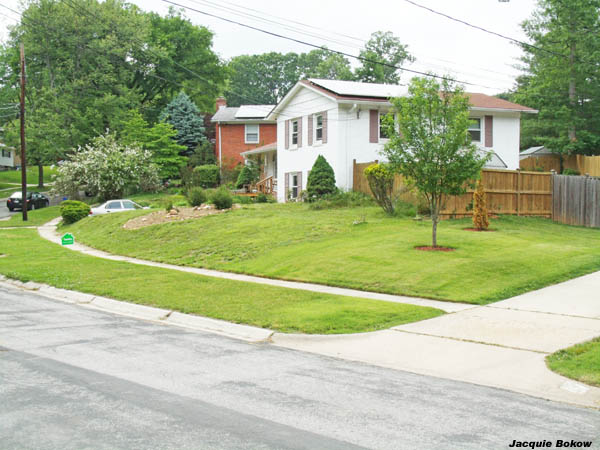
These two neighboring homes at 803 and 805 Malta Lane — at the northern end of
Caddington Avenue — simultaneously installed 4.6 kW of SolarCity solar photovoltaic
(PV) panels.
The next step was an engineering site audit, which involved measuring the roof’s
dimensions, assessing its structural integrity, and determining its orientation to the sun
in the morning and afternoon; evaluating the main electrical panel; and locating any shading
issues.
Since we live next door to each other (803 and 805 Malta Lane), we were able to schedule both
of our site audits and, later, the installation to take place on the same days. SolarCity
was very easy to work with in terms of concurrent scheduling for the various aspects of the
process. Plus, they handled all of the paperwork for the Federal and State incentives and
tax credits, the correspondence with Pepco, and the permits for the installation. They also
arranged all of the various inspections, etc.
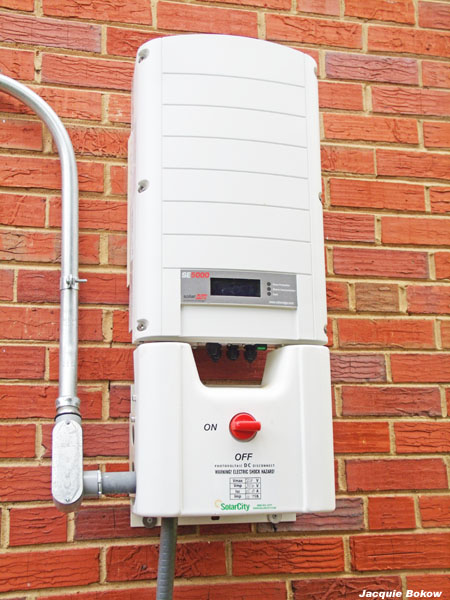
The inverter converts the DC (direct current) power from the solar panels into
alternating current (AC) power, the standard electrical current used in homes.
The designs for our 4.6-kilowatt photovoltaic array systems were completed in November. We
both have 20 panels; all of Lisa’s and mine are on situated on the east-southeast-facing
roof, while Ben and Jo Ann’s are split, with half facing east and half west.
The county and Pepco approved the designs in December, and installation was in January.
Once the installations were inspected and approved by the County and Pepco, Ben and Jo Ann
activated their system on January 31 and we flipped the switch on February 13.
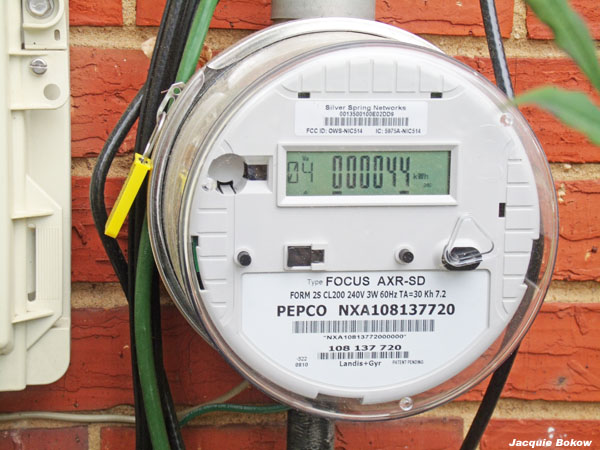
When the solar power system produces more power than the home needs, the utility “smart”
meter literally runs backward, giving the homeowner a credit.
The only up-front cost my family incurred was to have two trees removed, one of which was
dying and needed to come down anyway. Removing the other tree, begrudgingly done because it
would have blocked the morning sun, resulted in a 30 percent increase in production for our
system.
SolarCity includes a performance guarantee based on its calculations: if the system
doesn’t meet the goals, they will pay the difference. They continuously monitor the
system and will respond if performance declines. They will also take care of any necessary
repairs.
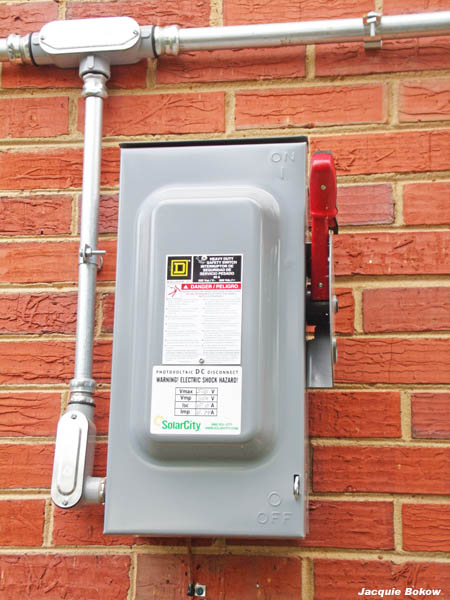
For both maintenance and upgrades, the DC Disconnect Box lets power be shut off.
When Pepco workers came to inspect the system, they installed a new, “smart”
electric meter that is capable of going backward, necessary for when the panels generate more
power than is used; this was actually a second new “smart” meter as the previous
meter installed only a couple of weeks prior was incapable of going backwards. It’s
very gratifying to see the electric meter wind backwards past zero, thus sticking it to Pepco a
bit. Since activation, both systems have generated more power than we’ve needed,
resulting in the only monies paid to Pepco equaling around $7.32/mo., which is only for the
distribution of power when the system isn’t generating.
Since turning the panels on, our system has generated 1,746 kWh and theirs has generated
1,741 kWh (as of May 16); our somewhat more southern exposure has resulted in a slightly higher
level of production, but that difference has diminished as the sun has risen higher in the sky
with the approach of the summer solstice. The most productive day of our systems thus far
was Friday, 11 May, with 31.72 kWh for ours and 30.04 kWh for theirs. The average power
used is between 12–16 kWh a day.
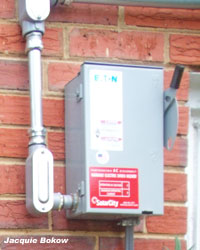
The AC Disconnect Box. If power from Pepco goes out, the homeowner won’t get power from the solar array, a common misconception.
A cool tool that SolarCity has is called SolarGuard, which allows us to view the
system’s production throughout the day, month, week, and year. It also calculates
our lifetime environmental benefits. Updated every 15 minutes, the information is
transmitted wirelessly and can be viewed online. Much to the amusement of our wives, Ben
and I are obsessed with checking the progress of our systems, especially on really sunny days.
We are all happy to talk about our systems in more detail. If you see us outside, stop
by and say hello. If there’s interest from a number of folks in the neighborhood,
we can set up a “solar party” with a representative from SolarCity. ■