Northwood News ♦ April 2011
Buddy, Can You Spare a Billion?
Dealing with Montgomery County’s Budget Problems
By Jim Zepp
Just like many other state and local governments, Montgomery County has coped with ongoing
budget shortfalls for the last two years. This has meant repeatedly reducing expenditures
and drawing on reserve funds as declining revenues have failed to meet previous projections.
Consequently, the County Council directed its Office of Legislative Oversight (OLO) to study the
structural budget deficit as this situation is not expected to substantially change in the near
future. The staff was asked to examine the expenditure and revenue patterns of the last
ten years and to project what is likely to happen in the next five years, assuming no significant
changes in spending and other sources of income for the County, such as funds received from the
Federal and State governments.
This analysis included operations by all County agencies (e.g., Transportation, Public Works, Police,
Fire, Health and Human Services, Recreation, Libraries, Housing and Community Affairs, Environmental Protection,
Consumer Protection, Corrections, Elections, etc.), Montgomery County Public Schools (MCPS),
Montgomery College, and the Maryland-National Capital Park and Planning Commission (MNCPPC). It
covered tax-supported activities, which are those funded through general taxes like income and property taxes
and fees that are not earmarked for specific purposes, such as solid waste disposal fees. For
Fiscal Year 2011, this amount was about $3.4 billion. The total FY2011 operating budget, including
all revenue sources, is about $4.3 billion.
On 19 Nov. 2010, OLO issued its Part I report on past expenditures and revenue trends and on 7 Dec. 2010
submitted its Part II report on options for achieving a long-term fiscal balance. (These documents,
among other related materials, are available
online here.
[Please note that URLs have changed since article was printed.]
This article includes some of the graphs from a Powerpoint slideshow summarizing the OLO staff findings. The complete set of slides can be accessed
online here.
Also a video of the OLO staff presentation and question/answer session with Council members at a public forum on the budget can be viewed at www.youtube.com/user/100marylandave#p/search/0/GfAvDiLUdvk.
The OLO staff characterizes the County’s budget issues in the following manner:
The imbalance today between projected revenues and desired expenditures in
Montgomery County, similar to the imbalance in other places, contains both cyclical and structural
components. A cyclical budget gap is a short-term imbalance between projected revenues and
desired expenditures that reflects the ups and downs of the business cycle. In contrast, a
structural budget gap exists when projections of expenditures exceed projections of ongoing revenues
on a persistent and recurring basis. The distinction between the two is that a structural budget gap
continues to exist even when revenue growth resumes.
A common ingredient of the budget challenge facing jurisdictions across the country is the
increasing portion of tax-supported budgets that must be allocated to fixed spending commitments.
In Montgomery County, these commitments include debt service, health insurance for active and retired employees,
pension plan payments, current revenue contributions to the capital budget (paygo), and contributions to
the County’s fund reserves. A structural budget problem becomes increasingly evident when
the projected cost increases of a government’s commitments exceed its projected revenue growth.
This is precisely the situation facing Montgomery County for the foreseeable future.
The main points of the OLO staff reports are that:
- The County’s tax-supported expenditures went from $2.1 billion in FY2002 to a high of
$3.5 billion in FY2009, which was a 64% increase. Because of recent revenue shortfalls, spending
has been reduced to $3.4 billion in FY2011. Even adjusting for inflation and population growth,
the County’s spending has grown substantially over time.
- In FY2011, spending is divided among the four major agency groups in the following proportions,
which have been relatively constant over the years:
| MCPS | 57% |
| County Government | 34% |
| Montgomery College | 6% |
| MNCPPC | 3% |
- Personnel costs (salaries and benefits) account for 82% of the County budget expenditures;
other expenses (e.g., utilities, supplies, travel, training, etc.) are 18% of the budget.
- Personnel costs have increased from $1.7 billion in FY2002 to a high of $2.8 billion in
FY2010, which is a 66% change.
- The overall number of employees have increased by a much smaller proportion of only 15%
at its maximum between FY2002 and FY2008. [NOTE: Workyears are used to simplify calculations
and comparisons by deriving full-time equivalents across any part-time employees, e.g., two half-time
(50%) employees equals one full-time (100%) employee.]
-
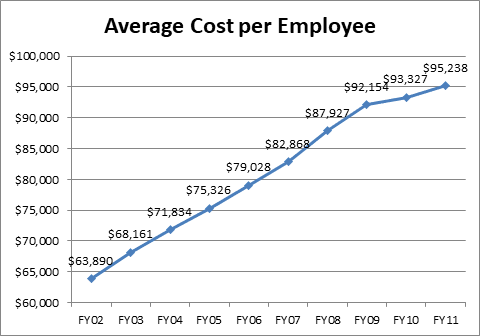
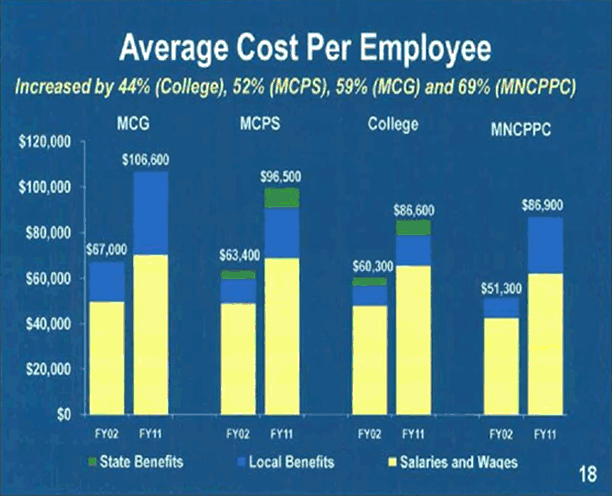
The “Average Cost per Employee” chart (right) displays the effect of these two trends
on the average cost per employee, a 49% increase over the ten-year period. This growth
would have been even larger except for the moderation in the last two years because of the budget shortfalls.
- However, personnel cost increases have varied by agency group between FY2002 and FY2011. The
County Government agencies include public safety employees, who have special provisions for earlier
retirement ages and compensation and benefits that affect this category’s personnel costs and
were not separately reported in most of this analysis.
- Due to the recent revenue shortfalls, the agencies have reduced their staffs by about 1,200
employees through buyouts, retirements, and not filling vacant positions. However, these have
not uniformly impacted all agencies. MCPS and Montgomery College still have substantially more
employees than they did in FY2002, while County government has had a minimal increase, and MNCPPC had
its staff reduced (see “Tax Supported Workyears” table, below).
| Tax Supported Workyears |
| | FY 2002 | FY 2011 | % Change |
| All Agencies | 26,702 | 29,400 | +10% |
| MCPS | 17,085 | 19,439 | +14% |
| County Government | 7,347 | 7,374 | +0.4% |
| Montgomery College | 1,363 | 1,773 | +30% |
| MNCPPC | 907 | 814 | -10% |
-
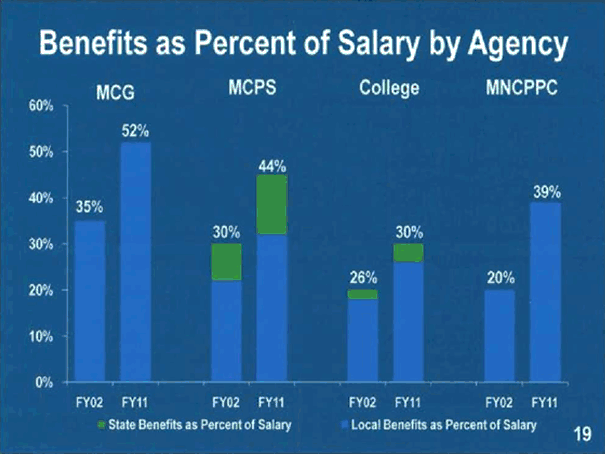
Growth in the costs of employee benefits as relative to salaries has also driven up the County’s
expenses (see “Benefits as Percent of Salary by Agency,” right).
- Another major cost that is expected to grow substantially in the next five years is the County’s
debt service. This is the annual payment of principal, interest, and issuance costs for bonds sold
by the County, mainly for capital improvements (e.g., building new schools, park and recreational facilities,
roads, etc.). Under the current obligations, this expense will go from $259 million in FY2011 to
$391 million in FY2016, a 51% increase in five years.
Projected Tax Revenues
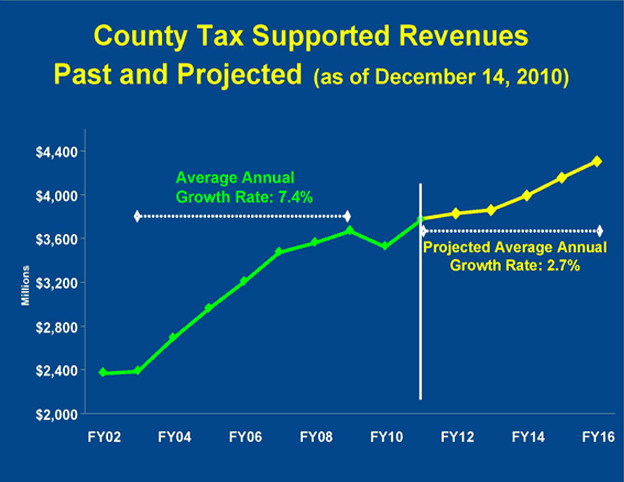
The OLO staff have projected the County’s estimated tax revenues through FY2016. It assumes an
economic recovery starting in 2013 with a modest annual growth rate of 2.7% as compared with the 7.4%
average annual growth of the pre-recession years. (See “County Tax-Supported Revenues,” left.)
The Bottom Line
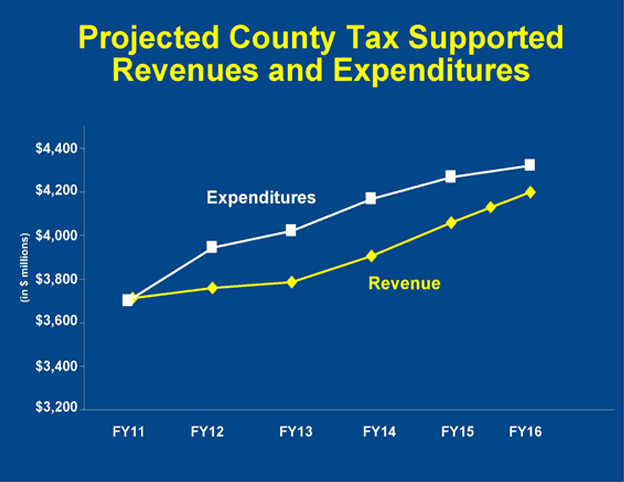
So what does this all mean? The OLO staff concluded that, if current trends and conditions hold, then
the chart labeled “Projected County Tax-Supported Revenues and Expenditures” (right) is the
likely financial future for Montgomery County: a continuing budget deficit of about $100 million
or more a year for the next five years.
This may be considered optimistic since it requires other sources of funding to remain constant.
For FY2011, the County received about $610 million in funding from the State and Federal governments.
For example, it has been estimated that some of the Federal budget cuts being considered could result in
as much as another $90 million loss in revenues to the County because of the many Federal agencies and
contractors and their employees located here.
It Gets Worse
As was reported in the 21 March 2011 Washington Post, Montgomery County’s
pension and retiree health accounts are underfunded by more than $4.8 billion. It would require about
$20,300 from every family in the County to make up these shortfalls.
Some Alternatives to Solving the Shortfalls
Because of the scale of the looming and continuing deficits, no single solution will close the fiscal gaps
facing the County. The choices involve which expenditures to cut and by how much and which taxes and
fees to raise and by how much. All of these will require substantial changes in order to meet the
multimillion dollar deficits:
-
Cut staff/programs. Because of the large financial numbers involved, cutting staff
is
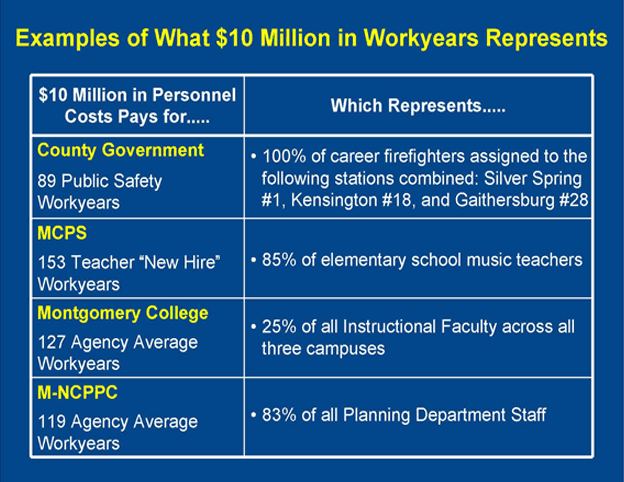
essentially eliminating whole programs or services. The OLO staff produced these examples to illustrate
what a $10 million expense reduction could mean (see “Examples of What $10 Million in Workyears
Represents,” right).
- Reducing employee salaries and benefits. This has been a controversial topic involving
negotiated labor contracts. However, if the costs per employee are not reduced, then the County
will have to further reduce the number of staff and cut services to the public. A subset of this
issue is that benefits are not uniform across all of the agencies. There are proposals to change
this situation so that all employees receive equal treatment in terms of employee contributions and
pension plans. However, this also will involve changing labor agreements.
- Consolidating agencies and services. This could eliminate redundant administrative costs
and duplicative services provided by multiple agencies. The County appointed a special
Organizational Reform Commission to investigate ideas for savings through possible mergers. An
example is the Commission’s recommendation to fold the MNCPPC Park Police into the County Police.
This has met with considerable opposition, so it has been dropped. Other recommendations face arguments
about actual savings and the cost of merging responsibilities and staffs. The Commission’s report
is available
online here.
- Raising taxes and fees. In FY2011, the County’s tax revenues come from the following sources:
| Property taxes (subject to charter limit) | 39% |
| Income taxes | 28% |
| State and Federal government aids | 16% |
| Other taxes | 12% |
| Program fees | 5% |
In the current economic conditions, many may argue that raising taxes and charging higher or more
fees for public services is not appropriate solution. While some of the increased revenue may be
made progressive (based on the ability to pay), the large deficits involved would probably cost all
taxpayers more in order to close the sizeable financial gaps.
So What Can We Do?
I have tried to summarize a large amount of published information and have condensed some extensive
discussions on these issues. I encourage readers to further examine the provided references to
get a more comprehensive view on these issues that will affect our future quality of life as well as
personal income and expenses.
County Executive Ike Leggett recently submitted his FY2012 operating budget to the County Council.
Between now and May, the Council will be deliberating on this and other fiscal options. You can
express your opinions on the solutions to these budgetary problems
online here.
However, saving any programs, services, facilities, or staff requires finding other expenses to cut or
revenue sources that can be increased since the County is living beyond our means. ■