 |
Stories from the NFCCA Newsletter, the “Northwood News” |
|
Stories from the NFCCA Newsletter, the “Northwood News” |
Northwood News ♦ February 2011
You’ve probably noticed crews around our neighborhood digging up streets and replacing pipes. Rafael Muriel, a foreman for Curt and Sons, Inc. (supposedly in Mount Airy, Md., although there’s no listing), which is subcontracting to WSSC, said they were replacing 60 “laterals,” the sewer pipes that branch out from the main line, to the property line. Mr. Muriel stated that the work was being done because of an EPA complaint of pollution in the Chesapeake Bay due to pipes cracking and leaking.
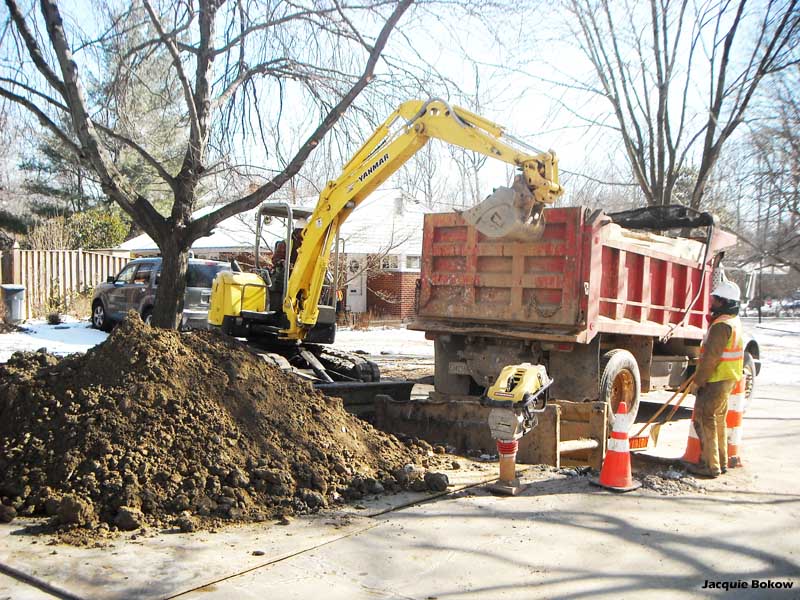
WSSC was found to have violated the Clean Water Act by failing to properly operate and maintain its sewage collection system, resulting in sanitary sewage overflows into area streams and backups into buildings. In a 2005 settlement to CWA litigation brought by the United States, Maryland, and a coalition of four environmental groups (including Friends of Sligo Creek), WSSC agreed to “perform extensive sewer system evaluations on its 26 sewer basins, covering more than 5,000 miles of sewer pipe to repair or replace any identified problems.” (Since WSSC has only 5,400 miles of sewer pipeline, I would presume it’s doing all of them.) The repairs and upgrades to its wastewater collection system and improvements to its water quality monitors will take place over 14 years and cost $200 million.
Specifically, the water and wastewater utility is to reduce raw sewage discharges by more than 26 million gallons per year and eliminate basement backups caused by inadequate capacity or poor operation and maintenance. WSSC must also implement emergency response and cleanup programs to address all overflows and will undertake a monitoring program in the Anacostia River (the Northwest Branch is a tributary of the Anacostia River, which flows to the Potomac River and the Chesapeake Bay).
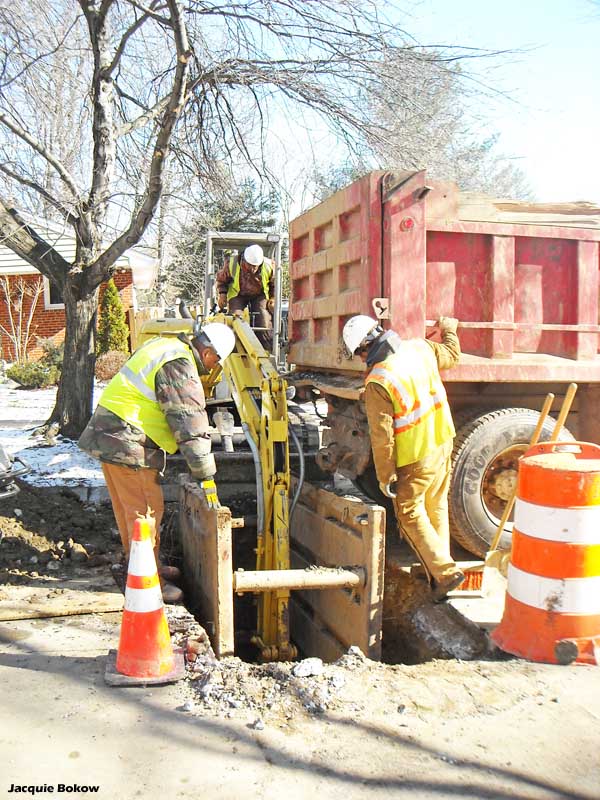
I spoke with Justin Hall, general superintendent for the WSSC project at B. Frank Joy, LLC (Hyattsville, Md.), which was hired by WSSC to renew sewer lateral connections to specific homes from the main pipe to the property line, where the utility easement stops. Joy uses felt coated with a liquid resin which then hardens, creating a new pipe inside the old pipe.
Mr. Hall said that the infrastructure throughout the U.S. is 40 to 50 years old (and most of the homes in our neighborhood are older than that), so the pipes are cast iron, clay, or concrete. They’ve been buried 12-14 feet down all that time, and they start to break down.
“You don’t think about it until it starts to happen,” said Hall. The repairs are actually to keep out the rainwater, which doesn’t need to be treated by WSSC, he explained. Older pipes that have cracks or separated joints allow rainwater in, which overwhelms the system.
Once everything’s finished, crews come back through and inspect the quality of the work with video cameras on all the lines; the hope is that any problems can be corrected without digging the pipes back up. Each contractor films (or hires someone to film) their own videos and turns these over to WSSC, where staff review them. ■
© 2011 NFCCA [Source: https://nfcca.org/news/nn201102g.html]