 |
Stories from the NFCCA Newsletter, the “Northwood News” |
|
Stories from the NFCCA Newsletter, the “Northwood News” |
Northwood News ♦ December 2009
Several hundred students at Forest Knolls Elementary School worked last month to plant 20 native trees on school property. The project was the brainchild of Clare Nielsen, a communications director and conservationist with Conservation International in Arlington, Va., whose older daughter, Emily, is in third grade at the school. Nielsen has lived in the neighborhood with her husband Kenny for close to 15 years.
“I got the inspiration for the project when I noticed the nice big trees in back of the school,” said Nielsen. “I believe this must be a remnant of the forest that was in place when Forest Knolls and the surrounding community was built. Mature oaks and hickories — the foundation of an important type of forest in our region — are growing there. It has some other nice smaller trees, too, like sassafras. But it was missing many kinds of smaller trees that create an ‘understory’ beneath the big trees. This layer of plants and trees is really important to birds and other kinds of wildlife because of the safety from predators its hiding places provide as well as the enriched sources of food. I started to wonder whether it would be possible to try to restore this area, to bring the ‘forest’ back to Forest Knolls. When Diane Lill started the PTA’s Green Committee at FKES last year and shared my vision, we got started.”
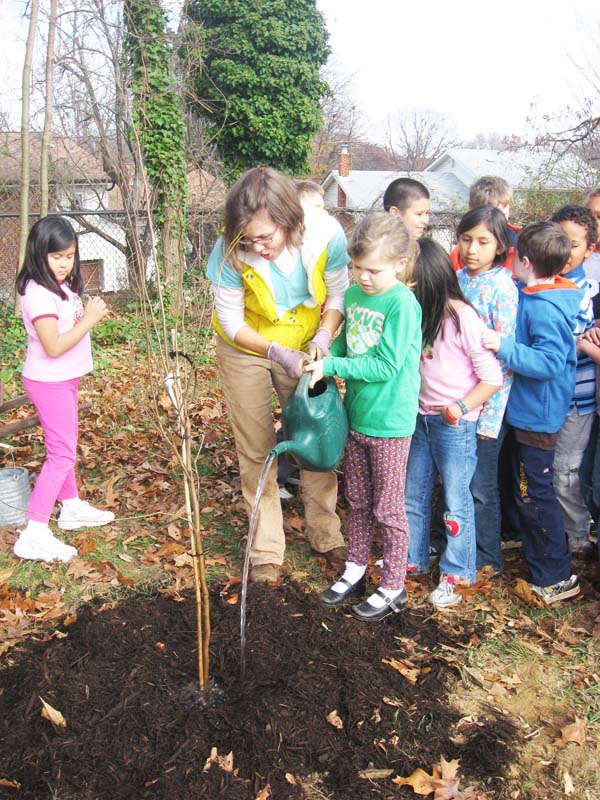
The trees were donated through a project called Trees for Schools, a joint initiative of Tree-mendous Maryland (Maryland Department of Natural Resources’ Forest Service) and the Sierra Club. Lill knew about this possibility from her work with other schools; Nielsen contacted them and negotiated the offer. They have now donated a total of 22 native trees to FKES (two planted last spring, a redbud and a white oak). The November planting was 10 redbud, one willow oak, three river birch, three old-mans-beard (a lesser-known small flowering tree known for its white fluffy spring flowers), and three dogwood. All are natives of our region; you could find examples of most of these growing in our neighborhood’s forest along the Northwest Branch.
Supplies for the planting (fencing, mulch, compost) were acquired through a grant Nielsen negotiated with the Maryland Urban and Community Forest Committee (MUCFC), a volunteer group of citizens, professionals, and government officials working to protect and enhance the state’s forest ecosystems. They liked the “Kids (Re)Foresting Forest Knolls” project because it combines tree planting with education (involving kids in learning how to plant and care for trees, as well as labeling trees and creating education signage, which are next phases of the project).
Almost all students at FKES were involved in the planting effort. All students in 25 classes participated in some way, from filling the holes to placing the mulch to watering their new trees.
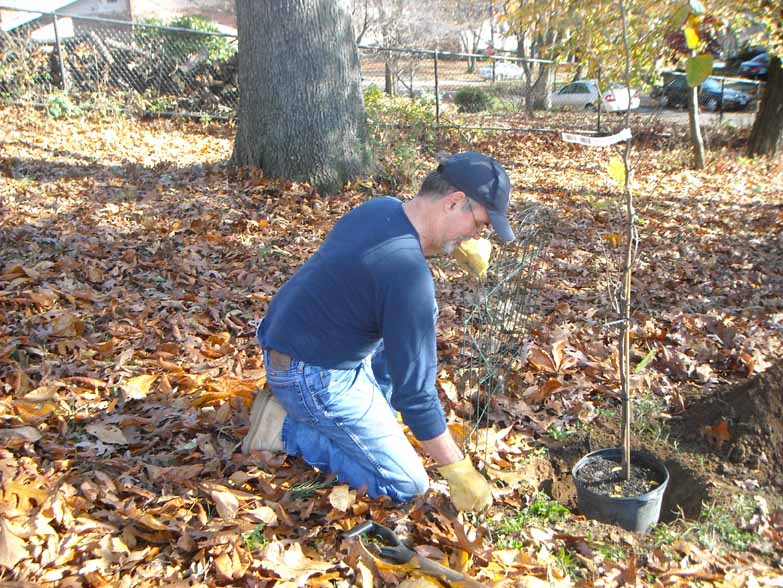
Each tree was named by the classes involved in its planting, inspiring a feeling of connection and responsibility. Names ranged from the descriptive Woody and Rosie (one dogwood was dubbed “Puppy”) to the mysterious Seraphina, the latter a wonderful name for one of the three graceful river birches.
“I hope they found that it is not hard to plant a tree and it’s one of the most important things we can do to help our planet,” said Nielsen. “Most people do not know that deforestation is a major cause of climate change, releasing 20 percent of carbon dioxide emissions annually, more than the entire transportation sector — all of the cars, trucks, planes, and trains in the world combined!”
The “Kids (Re)foresting Forest Knolls” project will keep on going after this tree-planting, with the installation of a nature trail, permanent tree identification signs, and creation of a field guide to the trees/nature on the school grounds. ■
© 2009 NFCCA [Source: https://nfcca.org/news/nn200912f.html]