 |
Stories from the NFCCA Newsletter, the “Northwood News” |
|
Stories from the NFCCA Newsletter, the “Northwood News” |
Currently, the U.S. Corps of Engineers and the County Department of Environmental Protection (DEP) have let contracts for a long-planned and long-awaited stream restoration project on the section of the Northwest Branch Stream Valley Park between Randolph and Colesville Roads. The project calls for completing a complex operation near Randolph Road before turning to another project involving the Lockridge tributary in our own neighborhood (see details below).
One of the aspects of the Randolph Road project is to construct an access road through woods on the west bank, south to a point approximately parallel with the Wheaton Regional Park Stable and Glenallan Avenue. To move heavy equipment along this access road, the engineers have had to construct heavy-duty wooden bridges. Their project permit calls for removing the bridges when the project is completed. Leaving the bridges would provide an extension of the Northwest Trail on the west bank as far as Old Randolph Road, where a masonry bridge provides passage across the Branch to the east bank.
It might be in the interest of the current users of the Northwest Trail to have an extension of the trail along this construction route. Presumably, our Civic Association could draft a letter to the DEP calling for modification of the permit before the bridges are removed.
A few years ago, the Washington Suburban Sanitary Commission (WSSC) completed a sewer renovation project that involved installation of temporary wooden bridges. We tried at that time to have the bridges retained at the termination of the project. This was refused; however, the County Park Department took our recommendation under advisement and eventually allocated money for the several composite bridges we now have along the middle reach of the Northwest Branch.
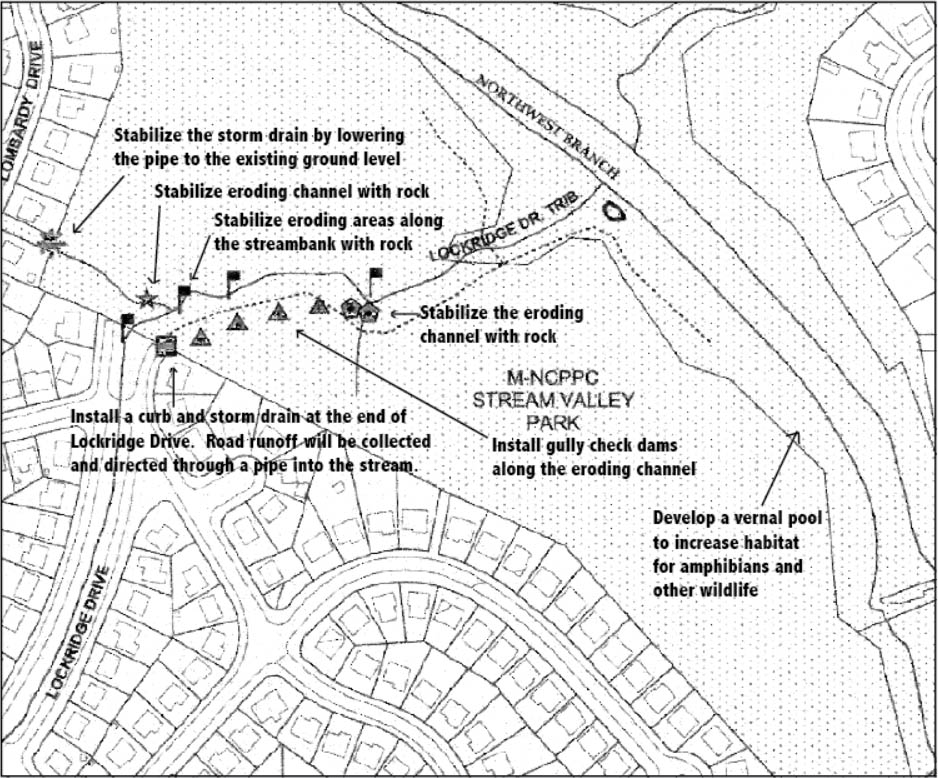
The current County Park budget is strained, so a request for new bridges may not be feasible; therefore, leaving the “temporary bridges” could be a useful option.
The stream restoration project for Lockridge Drive will begin at the entrance of the stream valley park — located at the east end of Lockridge Drive — and continues downstream to the confluence with the Northwest Branch. The purpose of the project is to stabilize erosive areas along the stream valley and improve habitat for amphibians (frogs, etc.). Activities involve:
The Lockridge Drive Tributary Stream Restoration Project is a cooperative partnership between the U.S. Army Corps of Engineers, Maryland National Capital Park and Planning Commission, and Montgomery County Department of Environmental Protection. ■
© 2001 NFCCA [Source: https://nfcca.org/news/nn200110e.html]