North Four Corners News ♦ December 2023
Nurturing Nature
Porcelain-berry: The Invasive Vine Taking Over Our Neighborhood
By Jennifer McGuire Cox
If you walk down any street in our neighborhood, within a few minutes you’re likely
to meet an invasive vine that is quickly strangling our community: porcelain-berry.
While some might think the small white flowers and colorful berries are a nice
addition to their yard, the vine spreads prolifically, quickly taking over yards and
weakening and killing other plants, shrubs, and trees nearby.
What Is It and What Does It Look Like?
Porcelain-berry
(Ampelopsis glandulosa, var. brevipedunculata) is a climbing,
woody vine in the grape family. It was introduced to America from Northeast Asia in
the 1870s as a landscape plant, popular for its durable groundcover qualities, but
eventually spread to the wild. It is now commonly found throughout the East Coast
and is slowly spreading westward across the United States. It is of particular
concern in the southeastern United States where its spread is often unchecked.
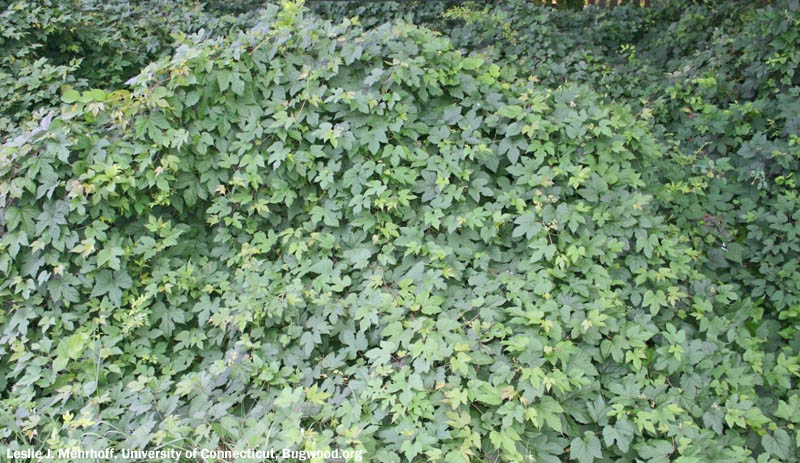
Porcelain-berry easily outcompetes native plants, reducing species diversity and impacting habitat for wildlife.
The most obvious characteristic of porcelain-berry, other than being a vine, is its
bright, multicolored berries — ranging from purplish red to dark blue and pale pink
— that emerge in early fall. These berries spring from its hundreds of white
blooms that develop in June to August. Its heart-shaped leaves also resemble those
of grape vines, deeply lobed, and it has nonadhesive tendrils at the base of each leaf
that help it climb and spread.
In the fall, the vine loses its leaves as the berries are eaten or dropped on the
ground below. It will re-emerge in the spring with new blossoms and leaves and,
eventually, new berries.
How Does It Spread?
Porcelain-berry is spread in two different ways: by animals and vegetatively.
Birds and other wildlife, such as small mammals, eat the colorful berries and spread the
seeds to new areas in their droppings. This is often how porcelain-berry first gets
established in many yards. The seeds then sprout, and those that do not can wait
for years in the soil before perfect conditions lead to their germination. The
plant, once established, can also resprout from its roots, creating a number of new vines.
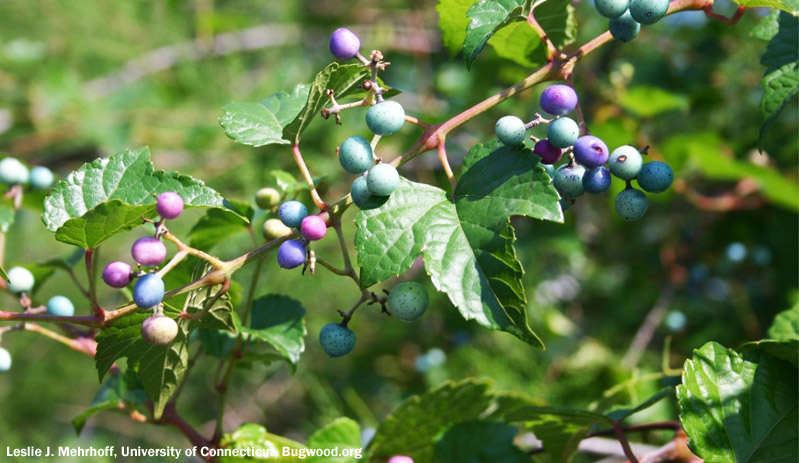
The berries of the porcelain-berry, which emerge in the fall, hang above the vine and appear pink, blue, and purple. The leaves of the plant are heart-shaped or deeply lobed, with 3-5 divisions.
Why Is It Bad?
Porcelain-berry is a very aggressive and opportunistic plant that can take over disturbed
areas as well as forest edges, pond margins, and streambanks. The vine grows
quickly, forming thick mats that crowd out native plants and vegetation, making it
difficult if not impossible for them to grow. This reduced diversity of plant
species reduces habitat for wildlife.
In addition to taking over groundcover, porcelain-berry can use its tendrils to climb
shrubs and trees, reaching heights of 20–25 feet. This not only blocks out sunlight
but the extra weight weakens the tree and can lead to its eventual death. In short,
one vine can quickly take over your yard and spread to the yards of your neighbors before
you know it, wreaking death and destruction in its wake!
How to Tell the Difference Between Porcelain-berry and Native Grape Vines
While porcelain-berry is pretty distinct, the plant is in the grape family and can, therefore, be confused for native grape vines. How do you tell the difference?
- Look at the vines. Native grape vines are dark brown whereas
porcelain-berry vines are gray-brown and noticeably bumpier. Porcelain-berry vines
are also covered in lenticels (raised spots that allow gas exchanges), and do not peel,
unlike native grape vines.
- Look at how the flowers/fruits hang on the vine. The flowers and fruits
of native grapes will hang below the vine, whereas porcelain-berry flowers and fruits
hang above.
- Look at the color of the fruit. Whereas the fruit of both native grapes
and porcelain-berry start off pale green, the berries of native grapes ripen to a dark
purple or black. Porcelain berries will ripen in many different colors, including
pink, blue, and purple.
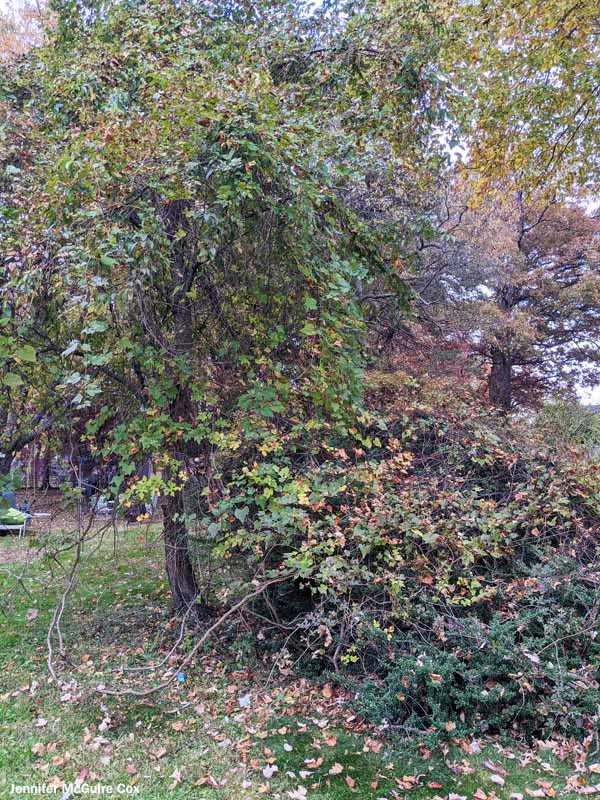
Porcelain-berry taking over shrubs and trees in a yard in our own neighborhood.
How to Remove It
There are a number of methods for removing porcelain-berry. The easiest way is
through early action. As soon as you see a seedling emerge, you should remove it,
and the roots, completely. Be prepared for repeated removals, as seeds that did not
germinate might still be viable in the soil and start to grow. In addition, any
root fragments left in the soil can result in new growth. Hand-pulling vines in the
fall or early spring will prevent flowers and, thus, the plant from producing seeds the
next season.
If the vine is already producing fruit, make sure to collect all the berries when
removing the plant to prevent seed dispersal and take time to remove the entire root
system to prevent it from coming back. If the vine is well-established and is
spread over a large area, chemical treatment may be necessary in conjunction with manual
methods.
If the vines have spread to trees and shrubs, don’t just pull on the vines to
get them off, as this will likely do more damage to the vegetation. Instead, using
pruners or loppers, cut an opening, or window, into the porcelain-berry at ground level
and again about two to four feet off the ground. This will eventually lead to the vine
dying off of the tree and help in the tree’s recovery.
[Cox lives on Belton Rd.] ■
