 |
Stories from the NFCCA Newsletter, the “North Four Corners News” |
|
Stories from the NFCCA Newsletter, the “North Four Corners News” |
North Four Corners News ♦ December 2022
On 10 November, NFCCA testified before the Montgomery County Planning Board on the proposed alternatives to the Bus Rapid Transit (BRT) plan that are mapped out in the 2022 draft US 29 Mobility and Reliability Study (the 2022 study). Despite the concerns raised by NFCCA about the impact that a median busway would have on our community, the Montgomery County Planning Board approved the staff’s recommendation for a Dedicated Median Bus Lane rather than a Managed Lane (Bus/HOV) on US Route 29/Colesville Road. The Planning Board staff’s reasoning for recommending the Dedicated Median Bus Lanes option is contained in the US 29 Mobility and Reliability Study, Part 2 Alternatives Selection, US-29-BRT-Alternatives-Staff-Report-2022-11-02_Final_Rev.pdf (montgomeryplanning board.org).
At this writing, the Montgomery County Council has not yet acted, but a hearing is scheduled on 28 November before the Transportation and Environment Subcommittee, with consideration by the full Council on 29 November.
In our testimony, NFCCA argued that the Managed Lane alternative is a much better option because, according to the 2022 study, bus drive time would be cut in half by a Managed Lane and is marginally faster than drive time for the FLASH bus in a Dedicated Median Bus Lane. Plus, the Managed Lane alternative benefits HOV car riders and all buses, not just the FLASH; Express buses would be the only transit permitted in the Dedicated Median Bus Lane.
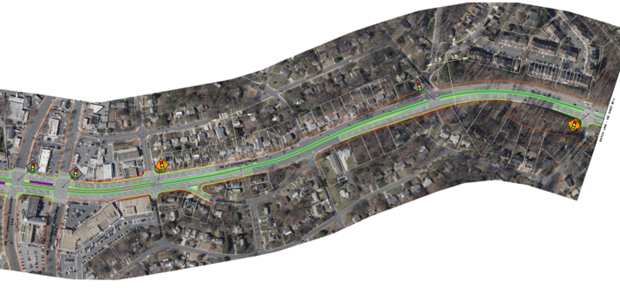
The chief concern that NFCCA raised was that a dedicated median busway will reduce entry/exit points on US 29 by blocking off Lorain Avenue. Although south-bound Woodmoor residents would be able to turn at Timberwood Avenue into their neighborhood at a proposed traffic light, the current illustration of the plan would block north-bound drivers from turning left there into our neighborhood.
If only one way remains into or out of North Four Corners from US 29 at Southwood Avenue, NFCCA pointed out that, with Southwood Avenue as the only access, the turn lane and traffic signal time on US 29 should be lengthened, along with more signal time for outbound cars. Outbound neighborhood traffic already backs up significantly on both Southwood and Eastwood Avenues at that traffic light.
Also, the illustration in the 2022 study shows that the Dedicated Median Bus Lane widens in Four Corners from a single lane to a two-lane busway. Reducing available lanes will worsen this chokepoint right before many drivers move onto the beltway.
NFCCA requested a traffic study analysis to evaluate neighborhood impact and whether allowing a north-bound left turn at Timberwood Avenue could retain a north-bound entry point into North Four Corners to make up for losing access via Lorain Avenue. We also asked that the adjustments suggested by NFCCA should be evaluated during the engineering phase if the Council adopts the Dedicated Median Bus Lanes alternative.
In endorsing the Dedicated Median Bus Lane alternative, Planning Board staff argued that, “When one alternative (Managed Lanes) improves both auto and transit travel times, and a second alternative (Median Bus Lanes) only improves transit travel times, it is the second alternative that is going to best incentivize people to make the switch from driving to taking transit.”
NFCCA criticized the $128 million investment in Dedicated Median Bus Lanes, because this alternative does nothing to relieve drive time for cars and trucks, including carpoolers and other transit riders (Metro and RideOn) as well as those who must use a vehicle to commute (e.g., the equity argument that a ladder cannot be taken on a bus). It is unproven that large numbers of suburban residents will abandon their cars in favor of public transportation.
NFCCA urged that a better investment of taxpayer dollars would be to adopt the Managed Bus Lanes alternative, measure over time how this improves adoption of public transit usage, and determine in the future if a further investment in a Dedicated Median Bus Lane is warranted.
NFCCA stated that the decision to pursue Dedicated Median Bus Lanes would sacrifice the quality of life for Four Corners residents who must live with the inconvenience and cut through traffic resulting from many years of transportation decisions that have favored moving the maximum volume of traffic through Four Corners. In closing, NFCCA noted that the Dedicated Median Bus Lane alternative is costlier, does not improve drive time conditions on US Route 29, and, more specifically, would limit neighborhood access for Four Corners residents, increase neighborhood traffic backups, further intensify cut-through traffic, and add two additional traffic signals along this half-mile stretch of US 29.
More information about the BRT alternatives can be found in the powerpoint presentation offered at a 13 October public meeting; see www.montgomerycountymd.gov/dot-dte/Resources/Files/US29Study/US_29_Mobility_Study_Project_ Findings_10_6_2022_CAC.pdf. ■
© 2022 NFCCA [Source: https://nfcca.org/news/nn202212h.html]