 |
Stories from the NFCCA Newsletter, the “Northwood News” |
|
Stories from the NFCCA Newsletter, the “Northwood News” |
The start date for the FLASH bus rapid transit on US 29/Colesville Road is currently being finalized for later in Fall 2020, according to an official with the Montgomery County Department of Transportation (MCDOT). US 29 FLASH will operate between Burtonsville and Silver Spring, with closest stops at Burnt Mills and Four Corners.
In addition, MCDOT is putting the finishing touches on its US 29 Mobility and Reliability Study (US 29 Study), which is expected to be finalized in October. The US 29 Study identifies future potential Phase 2 changes to further streamline commuting time along the corridor between Tech Road and the Silver Spring Transit Center. MCDOT staff presented the study findings, alternative options, and recommendations at a Zoom Open House on July 22nd. A recording of this public meeting, along with the slide presentation and the full study, can be found under the project documents tab at www.montgomerycountymd.gov/dot-dte/projects/US29Study.
One of the options studied was adding a full-time, dedicated median bus lane from Tech Road to Sligo Creek Parkway, which would have significantly impacted traffic flow in the Four Corners area. This alternative would have affected our neighborhood by prohibiting left turns onto or from Lorain Avenue, restricting access to/from US 29 to a single point: the Southwood Avenue traffic light. To accommodate the median busway, lanes on US 29 would also have needed to be narrowed to as little as 10 feet from Stewart Lane in White Oak to Timberwood Avenue in Four Corners.
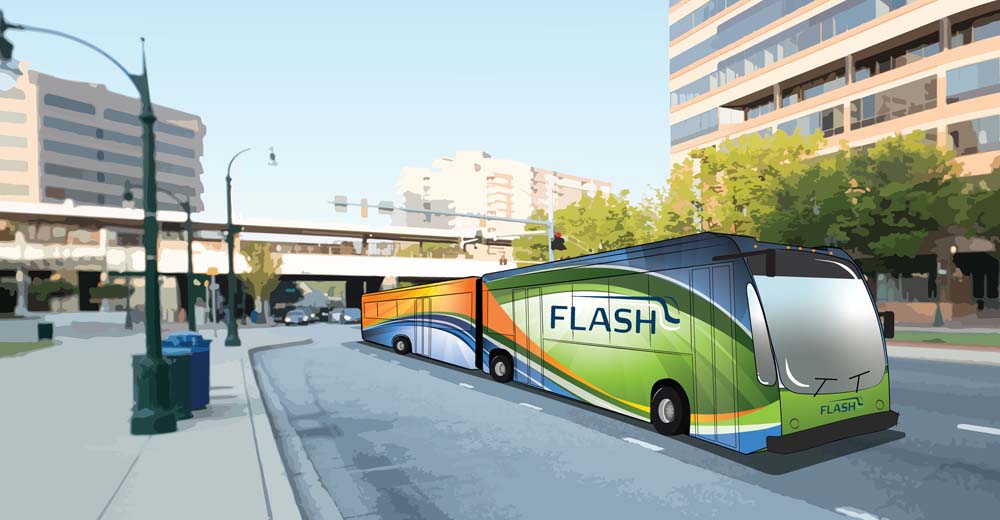
Instead, the US 29 Study recommended adoption of the Managed Lane approach. During the peak rush hours, this option calls for restricting the northbound and southbound left lanes on US 29 to FLASH buses and high-occupancy vehicles from Route 650/New Hampshire Avenue to Southwood Avenue. FLASH buses would operate in mixed traffic through the Four Corners area and stop at the near-finished stations located by the 4 Corners Pub and Montgomery Blair. If the Managed Lane recommendation is ultimately adopted, MCDOT is considering whether to relocate the FLASH stations at Burnt Mills and Four Corners into the median, allowing the FLASH buses to pull out of the managed HOV lane to pick up passengers and eliminating the need to change lanes to move to the curbside stations. For the final stretch from Dale Drive to Spring Street, there would be a single, rush hour reversible HOV/bus lane. With this option, there are no proposed new traffic signals or turn restrictions and there are no lane width changes. Ride On and Metro buses would continue to run in the right lane, because they stop more frequently.
In recommending the Managed Lane option over the Median Bus Lane concept, the US 29 Study considered a number of factors. Not only does the HOV Managed Lane alternative move cars faster up and down US 29 according to the analysis but, at $40-50 million, the cost estimate for developing the managed lanes is less than half of the estimated $100-110 million to construct a median busway. From Burtonsville to Silver Spring, morning commute times would be a projected 10 minutes faster for cars, but only slightly faster for the FLASH buses. The more significant time savings are projected for the evening rush; the northbound HOV lanes would save drivers 22 minutes and FLASH buses 8 minutes. Finally, the Managed Lane approach does not significantly change current traffic flow patterns in and around Four Corners.
The US 29 Study also recommends two other traffic lane reconfigurations in the Four Corners area: (1) adding a second lane to the westbound exit onto the Capital Beltway/I-495, and (2) enlarging lanes on Sligo Creek Parkway near the US 29 intersection. North of Four Corners, the US 29 Study makes a number of recommendations for intersection improvements at select congested interchanges to facilitate traffic along the corridor, which can be viewed by going to the full study at the county webpage cited above.
MCDOT staff will present the US 29 Study results and recommendations to the Montgomery County Planning Board (tentatively in mid-October) and the County Council (not yet on the agenda) in order to gather additional feedback. The County Council will select its preferred alternative(s) from the recommendations in the US 29 Study.
It is important to underscore that presently the County budget does not include any funding for planning, design, or construction of any part of the Phase 2 recommendations. Even if funding is secured, these potential changes are years away. Typically, once funding is approved, preliminary advanced design for the selected alternatives would take two to three years to complete, according to MCDOT staff. ■
© 2020 NFCCA [Source: https://nfcca.org/news/nn202010h.html]