Northwood News ♦ April 2019
Second in a Series on Local Child Care
Local Pre-Kindergarten Options
By Frances Spiegel
In Maryland, children are not required to attend school until kindergarten (age five by
September 1st) and, even then, the kindergarten requirement can be waived if a child is in
full-time daycare or if a parent feels that the child is not mature enough to attend.
However, by the time children turn four, many parents are looking for a structured pre-kindergarten
(pre-K) program to ease kids socially and academically into full-day kindergarten.
Public Programs
- Forest Knolls Elementary School. The Montgomery County Public Schools (MCPS)
system currently offers means-tested pre-K programs, including free full-day (8:50 a.m. to 3:20 p.m.)
pre-K at Forest Knolls Elementary School for families whose income that does not exceed 185 percent
of the Federal Poverty Level (FPL) (currently $47,638 for a family of four). This is the same
income eligibility requirement for the Free and Reduced Meals program. Registration is
currently open for the 2019–2020 school year. Application information is available by
calling 240.740.4530 and on the MCPS website.
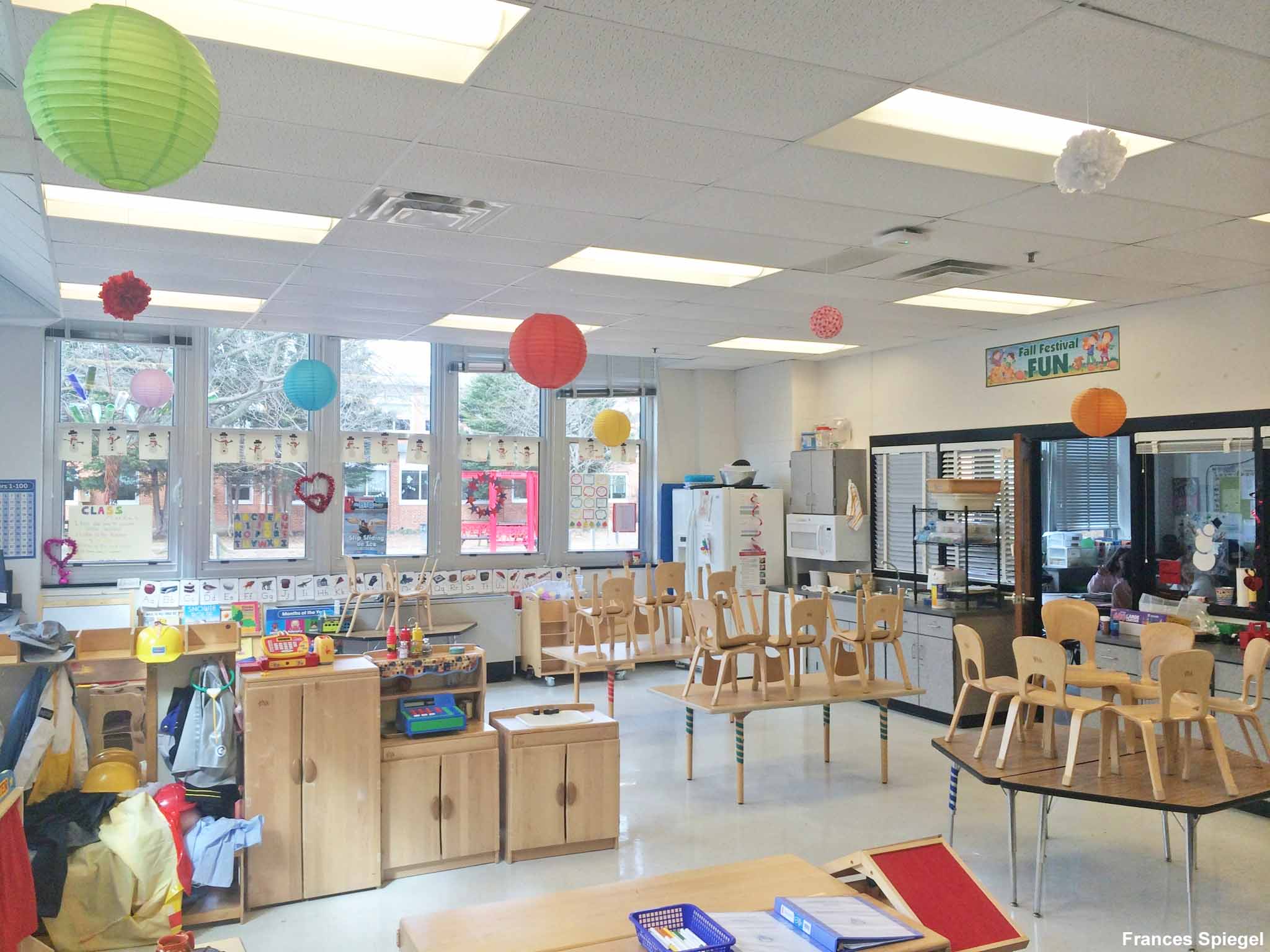
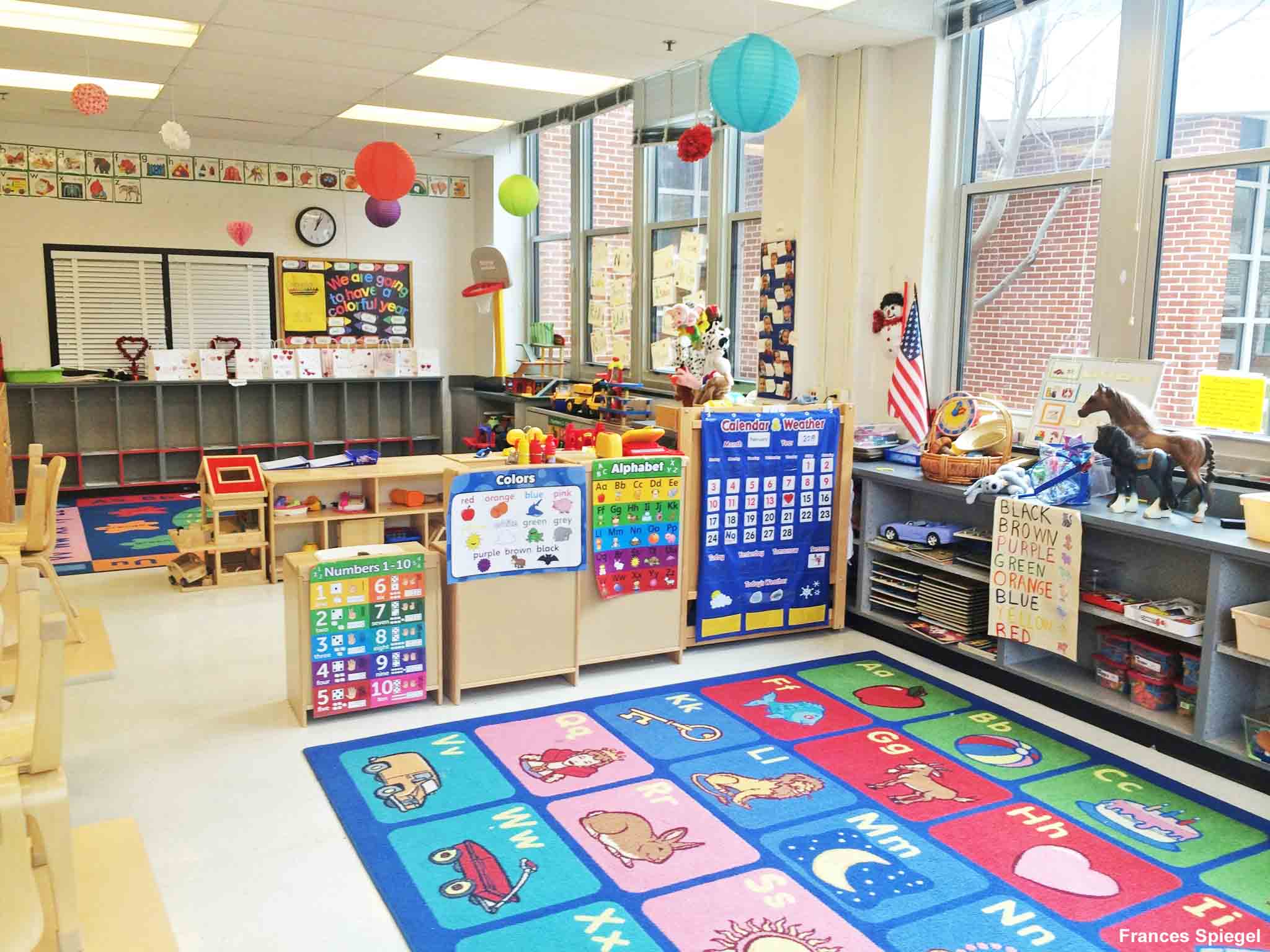
Both photos show Northwood High School’s engaging Child Development Lab.
- Northwood High School Child Development Lab. Northwood High School offers pre-K
taught by high school students, as part of their Child Development class, under the guidance of a
certified teacher. The Pre-K program costs $750 per child for the year, which runs October to
May. Pre-K students are in session 7:55 a.m. to 12:40 p.m., Monday to Thursday. Applications
for the 2019–2020 school year are currently being accepted on a first-come, first-served
basis. The class is capped at twelve students. Interested parents may contact
Maureen McEneaney at 301.593.3800. Information and applications are available on the
Northwood High School website. Blair High School also has a similar program.
Private Pre-K Programs
- Finding Programs. The website of Wheaton Area Moms
(www.wheatonareamoms.org) has an
extensive directory of local preschools. In addition, the Maryland State Department of Education
has listings of nonpublic nursery schools that offer state-approved educational programs and other accredited programs, available at
https://earlychildhood.marylandpublicschools.org/families/finding-child-care/early-care-and-education-program-lists. These listings are organized by county and city.
- Cost. Sticker shock for some pre-K programs is real. Consider this: pre-K
at the University of Maryland’s Center for Young Children at College Park costs $12,220 for the
year (for comparison, in-state undergraduate tuition at the University of Maryland is $10,595).
And this is not the most expensive pre-K program out there. Costs for private pre-K vary widely,
depending upon numerous factors such as whether it is a full-day or half-day program, the number of days
a week students attend, whether it is partially subsidized by a religious institution, whether it is a
co-op that requires parent participation, and whether teachers are specially credentialed in a particular
method of early childhood education (such as Montessori or Waldorf). All else being equal, co-op
programs and those affiliated with religious institutions tend to be less expensive. Some programs
offer financial aid; it doesn’t hurt to ask.
- Timing. The earlier families make contact with a preschool, the better —
particularly in this area. If you are looking for a pre-K program for this September, do not
delay. Waiting until summer may result in frustration. Many pre-K programs have application
deadlines in February and March but, even if the deadline has passed, it is still worth contacting the
school.
- Waitlists. If your child gets placed on a waitlist or in a “waitpool,” do
not despair; many pre-K programs indicate that they move through their waitlists fairly regularly.
“Plans change” is a common refrain heard from preschool administrators. Families
are also often on several waitlists and will only accept a spot from one of the schools, which opens
up spots for other students on the list.
Update on Universal Pre-K
During the 2018 election, many local candidates proclaimed support for “universal pre-K.”
As it turns out, “universal pre-K” in our context does not refer to publicly funded pre-K
for all children, regardless of family income, as it does in some other states.
The Maryland Commission on Innovation and Excellence in Education recommended in its January 2019
Interim Report that pre-K in Maryland be free to families with incomes up to 300 percent of the FPL
(approximately $75,000 for a family of four), with some public funding provided to families on a
sliding scale between 300 percent and 600 percent of the FPL. Families with incomes more than
600 percent of the FPL would have to pay the full cost to attend a public pre-K program.
These recommendations still need to be finalized, converted into legislation, voted on, and
funded. The bottom line: we are still several years away from state-wide
“universal pre-K,” which, even when fully implemented, is unlikely to result in
free public pre-K for all students.
[Frances Spiegel lives on Margate Road. She attended pre-K at the Northwood High School Child Development Lab in 1982 and turned out okay.] ■
Part 1: Local Child Care Options for Babies, Young Children