 |
Stories from the NFCCA Newsletter, the “Northwood News” |
|
Stories from the NFCCA Newsletter, the “Northwood News” |
Northwood News ♦ February 2013
There are folks in our neighborhood who let their cats roam freely; these cats return to their owners for shelter and to eat. A pet cat that has become lost or has been abandoned is defined by the ASPCA as a “stray.” But our neighborhood also has feral cats, which were either born outdoors or are strays that have turned wild in order to survive.
Stray cats are usually tame, comfortable around people (purring and meowing, rubbing against legs), and rely on humans for food. Feral cats (also called “free-roaming”) are quiet and keep their distance. Most are too fearful and wild to be handled. Feral cats are not adoptable and shelters will not accept them. They are not tame. Most feral cats exhibit wild, shy, or frightened behavior. Ferals often live in groups called colonies and take refuge wherever they can find food — rodents and other small animals and garbage. They will also try to seek out abandoned buildings or deserted cars — or even dig holes in the ground — to keep warm in winter months and cool during the summer heat.
Two women in our neighborhood participate in Trap-Neuter-Return (TNR) — also known as Trap-Test-Vaccinate-Alter-Release (TTVAR) — a method of humanely trapping unaltered feral cats, having them spayed or neutered and vaccinated against rabies, and releasing them back to the same location where they were collected to live out their lives. These women act as unofficial “colony caretakers,” providing food, water, adequate shelter, spaying/neutering, and monitoring the cats’ health. TNR — promoted by the ASPCA as “a humane and more effective alternative to euthanasia for managing and reducing feral cat populations” — has been shown to be the least costly as well as the most efficient and humane way of stabilizing feral cat populations.
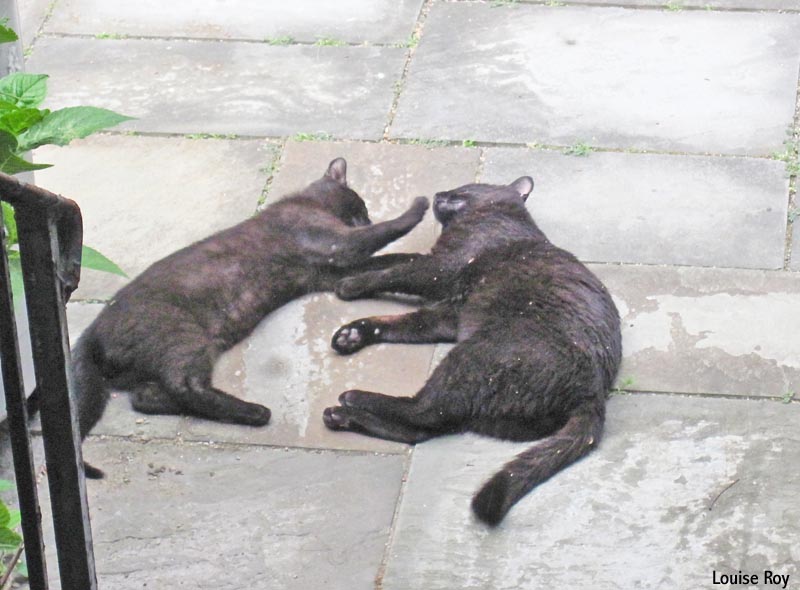
“Blacky is a feral I had been feeding for some years when he showed up in my backyard half dead in the cold of winter,” said Louise Roy (Eastwood Avenue). “I did not think he would survive the week but he did. One afternoon in the summer of 2011, he brought Casper with him and I found both on my back porch. I named him Casper as the antithesis to something that is all white. He was a hellion, hissing at me, scratching me, attacking my shoes, etc. I thought he had brain damage and really did not want to keep him. But Blacky kept bringing him over and they spent hours on the back patio together. That’s when I had Blacky and Casper neutered.”
Perhaps Casper was a stray. “Casper’s bad temper and rude behavior persisted until this past summer when he suddenly decided he wanted to come into the house,” said Roy. “Since then, he has made this house his castle, annoying my 11-year-old female cat (Minou, who has been spayed) no end,” said Roy. “Casper has become a surprisingly nice cat who loves to be hugged and will do anything to get a hug. He knows his name and follows commands (most of the time). The only problem is that he eats like a horse, has huge paws, weighs some 15 lb., and is as solid as a brick. His hair is gorgeous and I sometimes think he is a cross between a dog, a bear, and a cat. He seems related to Tikka in some way.”
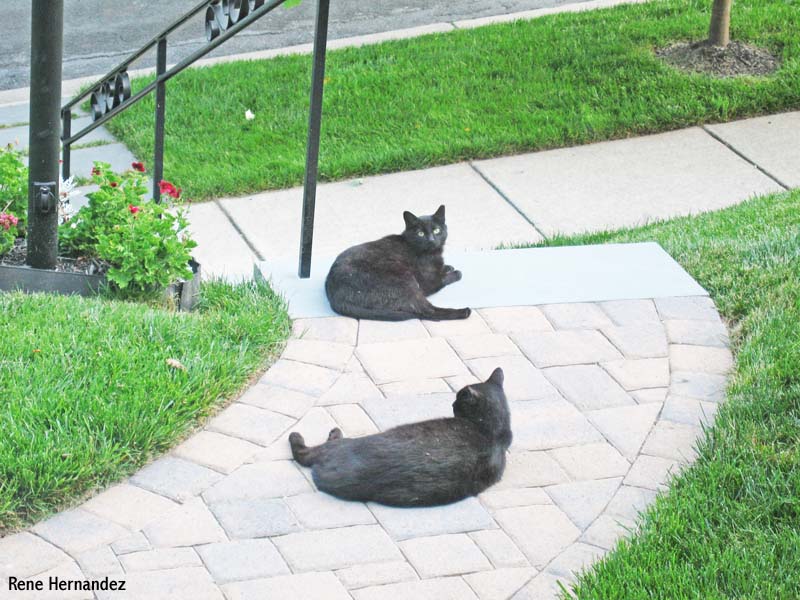
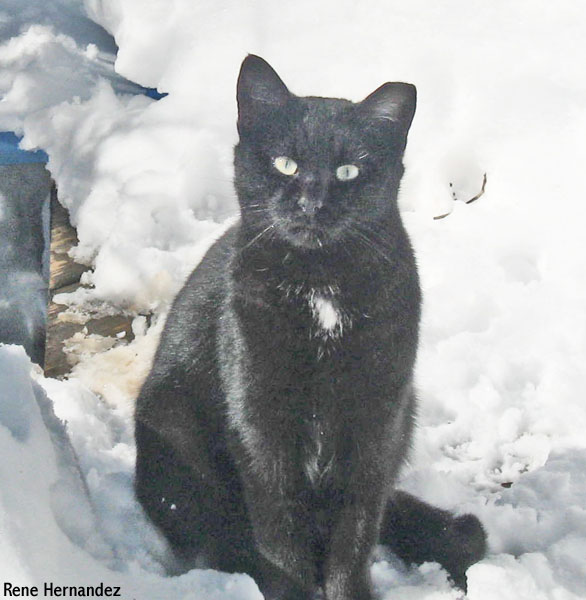
Tikka is the adult daughter of Spookee, and both are feral cats captured, spayed, released, and now cared for by Rene Hernandez (Belton Road). “I feed them daily and provide fresh water as well,” said Hernandez, who actually is terribly allergic to cats! “I’ve named the mom Spookee, since she gets easily spooked any time she sees me even look at her; she’s all black. Tikka has a white spot on her chest and her left rear paw has two white toes.”
Roy and Hernandez got advice and borrowed traps from local humane organizations.
“Alley Cat Rescue (www.saveacat.org) loaned me two humane traps and taught me how to use them,” said Hernandez. “The two cats were hanging about in my yard; I had been feeding them for a few months. Basically, I put the traps out for a few days and placed their food inside the traps without setting the traps for capture. They ate their food from inside the traps for three or four days. Then one morning I set the traps. Once I trapped them, I brought the cats to a vet [ACR] recommended, who neutered them for free. I donated about $80 to Alley Cat Rescue for their support, but there was no charge for their services.”
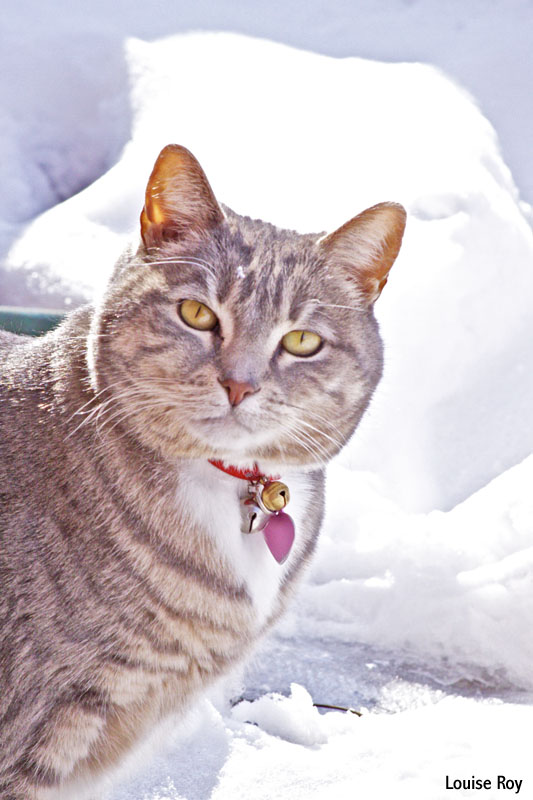
Roy used Metro Ferals (www.metroferals.org). “Besides neutering the cats,” said Roy, “they also gave them a flea treatment, dewormed them, and gave them rabies and FVRCP (distemper combo) shots.”
Both women retrieved the altered cats from the vets, brought them back home, and released them.
A feral cat that has been altered will have the tip of its left ear removed. Ear-tipping is a widely accepted means of marking a feral cat who has been spayed or neutered; that way, no one will try to alter it again.
Life for a feral cat is not easy. Feral cats must endure weather extremes — cold and snow, heat and rain; they also face starvation, infection, and attacks by other animals. Almost half of the kittens born outdoors die from disease, exposure, or parasites before their first year. If a feral cat survives kittenhood, its average lifespan is less than two years if living on its own. Feral cats which live in a managed colony — with a dedicated caretaker who provides spay/neuter services, regular feedings, and proper shelter — may reach 10 years.
Hernandez tried building an outdoor shelter for them, but the cats never used it; her next door neighbors think the cats may stay under their outdoor shed. Roy says she has never built an outdoor shelter for the cats. “The year we had three snowstorms,” said Roy, “Blacky disappeared for about 10 days between storms and I figured he was buried in snow somewhere, perhaps dead, but one day he showed up again and ate like a horse.”
February is National Cat Health Month, so make sure your cats are up-to-date on vaccines and have had a routine wellness exam in the last year. To find out more about feral cats, visit www.aspca.org, which provided the facts on feral cats for this article. ■
© 2013 NFCCA [Source: https://nfcca.org/news/nn201302l.html]