 |
Stories from the NFCCA Newsletter, the “Northwood News” |
|
Stories from the NFCCA Newsletter, the “Northwood News” |
When the rose in question is the multiflora rose, it is definitely an invasive exotic weed. Multiflora rose is a thorny shrub with arching branches. It blooms in May with tapering clusters of white flowers each about an inch across. It is native to Japan, Korea, and Eastern China. In 1866 it was introduced to America as rootstock for ornamental roses. In the ’30s, the U.S. Soil Conservation Service promoted it for use in erosion control and as living fences for livestock. State conservation agencies encouraged people to plant it for wildlife habitat, and transportation agencies planted it as crash barriers and to reduce headlight glare.
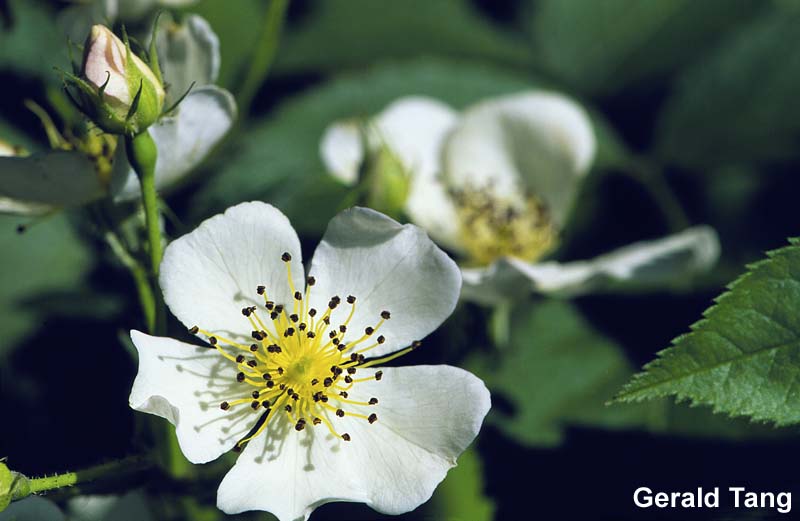
Able to live in a wide range of habitats, early to leaf out and late to lose its leaves, prey to very few natural enemies, and possessing incredible reproductive abilities, the multiflora rose took off like wildfire from these introductions. Today multiflora rose is found throughout the country except in standing water, deserts, and where winter temperatures exceed -28°F. It invades pastures and disrupts cattle grazing. It easily invades open woodlands, forest edges, old fields, and anywhere subject to disturbance.
Uncontrolled, it forms impenetrable thickets which can choke out virtually all native plants. A single shrub can grow to 15 feet high and can have a root crown with an eight-inch diameter. Studies suggest it is highly competitive for soil nutrients. It spreads by seeds, rooting at the tip of the canes, and plants arise from shallow roots. A single plant may produce a million seeds per year, and seeds can remain viable in the soil for 10-20 years. Passing through the digestive tract of birds enhances seed germination.
To control it, light infestations can be dug out or pulled as long as you have a strong back and very heavy gloves. Research has also documented that mowing or cutting it down three to six times within the growing season for two to four years can control its spread. However, the thorns are so sharp they can easily puncture mower tires, so if you plan to mow a lot of multiflora rose, experts recommend filling the tires with foam. Freshly cut stumps can also be painted with the herbicide glyphosate late in the growing season.
A few years ago, Charles Pritchard went after the multiflora growing between Lockridge Trail and the Creek. For the first time, it was possible to see the creek from that portion of the trail. However, it is beginning to creep back, and there are other areas of the park where it has completely taken over. If you would like to join the team of Weed Warrior volunteers working in Northwest Branch Park, call Carole Bergmann, Montgomery County Forest Ecologist, at 301.949.2818. If you think you might have multiflora rose in your yard but need some help identifying it, call Carole Barth [contact details redacted]. ■
© 2003 NFCCA [Source: https://nfcca.org/news/nn200306d.html]